The History of Apologetics
Trace the church's 2,000-year defense of the faith — and learn to give a reasoned answer for the hope that is in you.
Auditors are welcome to join at any point in the term — every session is recorded, so nothing is lost by starting late.
Defending the Faith, Answering the Age
Apologetics is the work of defending and contending for the truth. In this course you'll learn how the church has answered its critics for two thousand years — from the prophets and apostles, through the church fathers and Reformers, to the challenges of paganism, Gnosticism, rationalism, liberalism, and postmodern thought.
We evaluate every historical method from a firmly Reformed perspective, recognizing that true apologetics defends the faith without compromising the authority of Scripture, the depravity of man, or the sovereignty of God. You'll come away better equipped to reason with skeptics, strengthen your own faith, and engage friends and family with clarity and grace.
What You'll Learn
- The biblical mandate and methods for defending and contending for the faith.
- The historical development of apologetics from the early church to the present.
- How to evaluate the major methods — Classical, Evidential, and Presuppositional — through a Reformed lens.
- A working proficiency in the presuppositional method of Cornelius Van Til.
- How to confidently engage today's cultural, philosophical, and theological challenges.
- How to equip your own local church to give a reasoned, gracious defense.
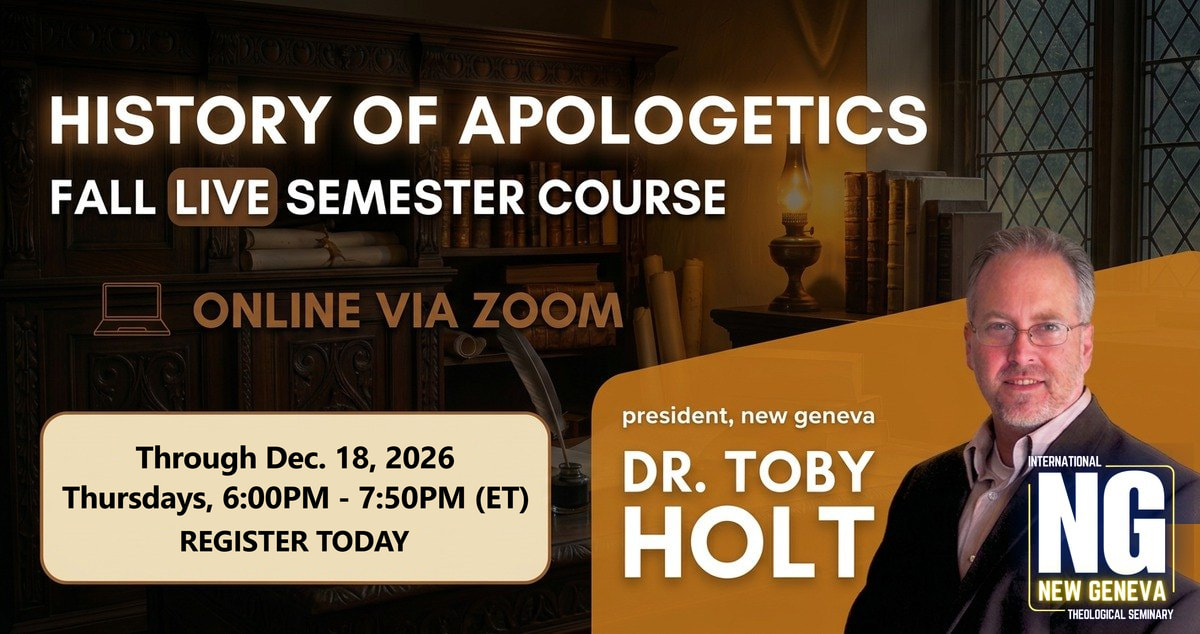
Taught by Dr. Toby Holt

An experienced church planter, expository preacher, and pastor, Dr. Holt's verse-by-verse Bible teaching has surpassed 1.9 million downloads on SermonAudio. He holds an M.Div. and D.Min. from New Geneva and now trains the next generation of pastors.
Course Schedule
What exactly is apologetics? It isn't about "apologizing" for what we believe — it's about offering a clear, reasoned defense of the hope we have in Christ. We'll look at the biblical mandate that calls every believer, not just academics, to this work.
You'll see how studying apologetics strengthens your own faith, clears away intellectual roadblocks for unbelievers, and glorifies God.
Every apologetic method rests on theology. We'll examine how a biblical view of human nature — specifically total depravity — changes the way we argue for Christianity, and why the Spirit's regenerating work takes the pressure off you to "argue someone into the kingdom." We'll also learn to engage skeptics with genuine love and humility.
Apologetics didn't start in the New Testament. We'll trace how the Old Testament dismantles the false religions of the Ancient Near East, beginning with Yahweh's defeat of the Egyptian gods at the Exodus — and learn to assert the exclusivity of the biblical God in a culture that demands pluralism.
From Elijah on Mount Carmel to Isaiah's exposure of wooden idols, we'll see the uncompromising stance of the prophets — and how their intolerance for idolatry helps us recognize the sophisticated idols people worship today: wealth, status, and self.
The Christian faith stands or falls on a single historical event. We'll explore how the apostles based their public defense entirely on eyewitness testimony to the bodily resurrection — and get the facts and arguments to take apart skeptical theories critics still recycle today.
How do we reach people who don't know the Bible at all? We'll analyze Paul's address at Mars Hill (Acts 17) — finding cultural touchpoints to build a bridge for the gospel while dismantling a competing worldview without compromising truth.
We'll study early apologists like Justin Martyr and Tertullian, who defended Christians against Roman accusations of atheism and cannibalism and argued for the moral and philosophical superiority of the Christian worldview — history that speaks directly to the church's renewed marginalization today.
The greatest threats often come from within. We'll explore how believers like Irenaeus fought off Gnosticism and Marcionism, learning to spot heresy and protect the congregation — because modern cults usually just recycle these ancient errors.
You'll learn to view life through Augustine's lens: the ongoing conflict between the eternal City of God and the passing City of Man — a framework for navigating modern political anxiety, knowing that while nations crumble, Christ's kingdom is unshakeable.
We'll examine Augustine's defense of God's sovereignty and goodness in a broken world, and his battle against Pelagianism — equipping you to answer the skeptic's questions about suffering while deepening your gratitude for grace.
We'll analyze Thomas Aquinas, scholasticism, and his famous "Five Ways" — learning their historical value but, more importantly, their limits in leading a spiritually dead heart to the true God. A humbling lesson: logic is a gift from God, but human philosophy can't take the driver's seat.
Unbelievers aren't truly ignorant of God — they are actively suppressing the truth. This shifts our approach from trying to "prove" God to exposing that suppressed knowledge.
Why do Van Til and Sproul defend the same faith so differently? We'll lay out the three main approaches to apologetics, which start from reasons for God (classical), from evidence such as the resurrection (evidential), or from God and His Word (presuppositional), and weigh each one's strengths and weaknesses, so their two books fall into place.
We'll test the classic arguments from cause, from design and from moral duty: what each one shows, where it stops short, and how to use it wisely. Then you'll begin to work out your own approach to defending the faith.
In the Enlightenment, from Descartes to Hume, philosophy began from human reason or experience rather than revelation, and well-meaning Christians gave up ground by subjecting the Bible to skeptics' demands for proof they could see and measure. You'll see where the church compromised, and learn to spot the same assumptions in modern atheism.
In the 1800s, higher criticism treated the Bible as a flawed human book, and theological liberalism reduced the faith to morality or feeling. We'll study J. Gresham Machen's 1923 book Christianity and Liberalism and his case that liberalism isn't a variant of Christianity but a different religion altogether.
We'll explore Francis Schaeffer's method of "taking the roof off" — pushing secular worldviews to their logical, despairing conclusions so the unbeliever recognizes their need for the gospel. Apologetics as pre-evangelism, ready to engage the art and philosophy your neighbors consume.
We'll examine R.C. Sproul's defense of the faith using classical logic, historical evidence, and a fierce commitment to Scripture — and how a Reformed view of God's sovereignty harmonizes with a vigorous intellectual defense.
We bring everything into the present: postmodernism, moral relativism, and the secular redefinition of identity and truth. We'll see how the culture shifted from "Is Christianity true?" to "Is Christianity good?" — and how to answer.
Apologetics belongs in the pews, not just the ivory tower. We'll discuss practical strategies for pastors, elders, and lay leaders to train their members — especially the youth — to give a reasoned, gentle defense at school and work.
Dawkins, Hitchens and Harris rest their case on one claim: that science is the only path to knowledge. We’ll show you that the claim itself cannot be established scientifically — and then press further, asking where the atheist got the uniformity of nature and the laws of logic his experiment already assumes.
The textbook calls it the problem of evil; in your study it arrives as a widow asking why God was silent. We’ll separate the argument that needs answering from the grief that needs a pastor, and look at what God gave Job — which was not an explanation.
Scripture has never been one authority among several in this course — it has been the ground the whole method rests on. We’ll trace how Jesus Himself treated the Old Testament, and why a defense that appeals to Scripture is not circular but consistent.
No argument has ever converted anyone, and the Westminster Confession says why: our full persuasion of Scripture’s authority comes from the inward work of the Holy Spirit bearing witness by and with the Word. You’ll see why that frees you rather than discourages you.
Twelve live sessions on Thursday evenings. Every session is recorded and posted to the class page.
Logistics
Books
The reading below is for students taking ST 513 for credit. As an auditor, you're not required to read any of it.
Frequently Asked Questions
No. The History of Apologetics has no prerequisites and is open to anyone who wants to grow in defending the faith — whether you're pursuing a degree, auditing for enrichment, or exploring seminary study.
Yes. Your first New Geneva course is free to audit, so you can sit in on ST 513 History of Apologetics at no cost. Auditors attend every live session and join the discussion, with no assignments, exams, or academic credit. The full audit policy is on the courses page.
The course runs twelve weeks — twelve live Zoom sessions on Thursday evenings, 6:00–7:50 PM Eastern, from 3 September to 3 December. There is no class during Fall Recess (15 October) or Thanksgiving (26 November). Every session is recorded and posted to the class page.
Tuition is $300 per credit hour; this is a 2-credit-hour course. Credit students complete the assigned readings, three short quizzes, a 5–7 page midterm paper evaluating a historical apologist, and a 7–10 page final project defending the faith against a modern worldview. Full details are in the syllabus.
That depends on how you take the course. Students enrolled for credit have required reading — Van Til's Christian Apologetics and Sproul's Defending Your Faith anchor the course, with Schaeffer's The God Who Is There for independent study and Baucham's Expository Apologetics and Machen's Christianity and Liberalism recommended alongside. If you're auditing, none of it is required — you're welcome to join every session and take part without any reading at all. If you'd like a place to begin, Sproul's Defending Your Faith is written as an introduction, and several primary sources we study — Justin Martyr and Irenaeus, and Augustine's City of God — are available free online.
You'll understand the major apologetic methods and their history, gain working proficiency in the presuppositional approach of Van Til, and be equipped to engage today's cultural and philosophical challenges — and to help train your own local church to give a reasoned, gracious defense.
Audit or Take for Credit
Join the class this term — audit along for enrichment, or enroll for credit toward your degree. Auditors may join at any point in the term; the recordings are on the class page from the first evening onward.
Audit the Course
Your first New Geneva course is free to audit.
- Attend every live class and join the discussion
- No assignments, papers, or exams
- Learn from the same lectures as credit students
- No application, transcripts, or references needed
- No formal academic credit awarded
Take for Credit
- Earn 2 credit hours toward a New Geneva degree
- Readings, quizzes, midterm paper & final project
- Graded feedback from Dr. Holt
- No prerequisites required
Sit In On This Class
Come as a guest to the live Zoom sessions and listen in — no application, no assignments, no exams.
Your first New Geneva course is free to audit. Sessions meet Thursdays, 6:00–7:50 PM ET, and every session is available on demand.
We’ll send you a Welcome note and Zoom link.
Prefer to talk first? Book a free 15-minute call with our registrar.
Take for Credit
Earn two credit hours toward your New Geneva degree. Share your details and our registrar will guide you through enrollment for this term.
New to New Geneva? You'll complete a short application — we'll walk you through it.