Overview of New Testament Greek
Unlock the original language of the New Testament in this introductory course.
Auditors are welcome to join at any point in the term — every session is recorded, so nothing is lost by starting late.
Read the New Testament in Its Original Language
The New Testament was written in Koine Greek — and reading it in the original opens layers of meaning that no translation can fully carry. This introductory course builds the foundational grammar and vocabulary you need to begin navigating the Greek text.
You'll learn to use modern lexicons and language tools to enrich your personal Bible study, avoid common interpretive and exegetical errors, and discover how a deeper grasp of the original language strengthens your faith, your witness, and your defense of the gospel.
What You'll Study
You'll come away with the foundational grammar and vocabulary to begin navigating the New Testament in its original Koine Greek, and to handle language tools and lexicons with care — enough to enrich your study, sidestep common exegetical errors, and strengthen your witness. It begins with the building blocks:
Greek Alphabet & Phonics
Study the foundational building blocks of Koine Greek, learning to confidently read, pronounce, and write the original language.

Core Grammar & Syntax
Understand how Greek sentences are structured — nouns, verbs, and cases — to unlock deeper layers of biblical meaning.

Using the Greek Tools
Work confidently with an interlinear, expository dictionaries, concordances, commentaries and Greek-enabled Bible software. This course does not teach you to translate on your own — for that, see NT 504A–C and NT 505.
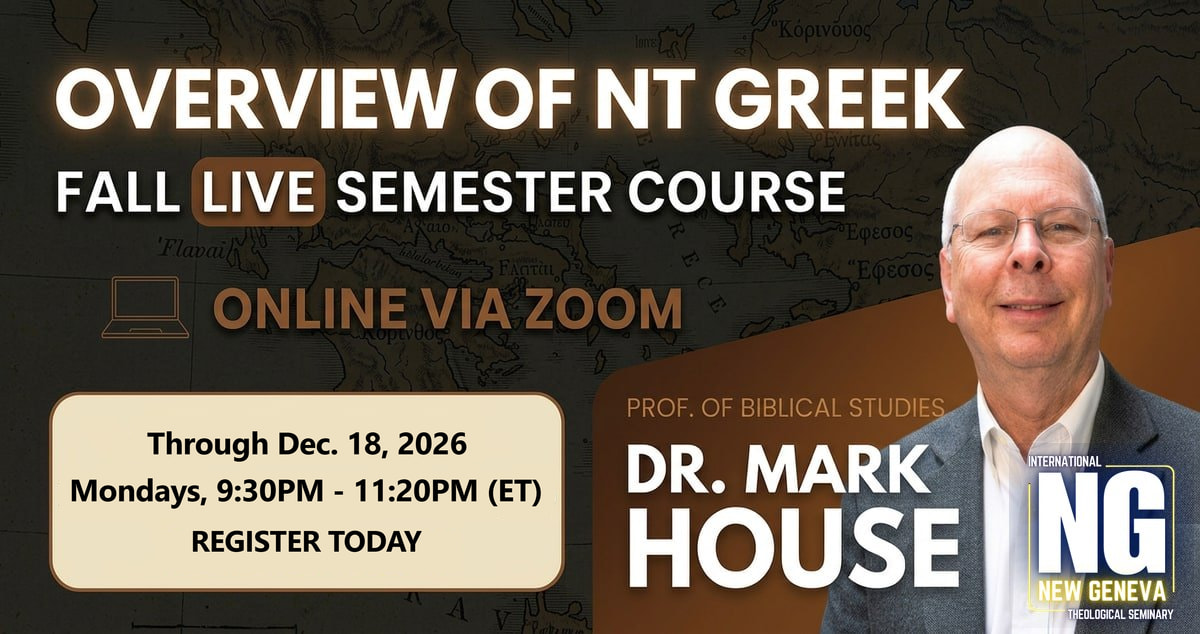
Taught by Dr. Mark House

Dr. House served as academic editor for New Testament and Greek at Hendrickson Publishers, editing the Compact Greek-English Lexicon and the Analytical Lexicon of New Testament Greek. He has taught at Talbot School of Theology, Fuller Theological Seminary, and in Ukraine, and brings twenty-five years of pastoral experience in the PCA.
Logistics
Frequently Asked Questions
No. This is an introductory overview that begins with the Greek alphabet — no prior knowledge of Greek is required. It's open to degree students, auditors, and anyone eager to read the New Testament in its original language.
Yes. Your first New Geneva course is free to audit, so you can sit in on NT 511 Overview of New Testament Greek at no cost. Auditors attend every live session and join the discussion, with no assignments, exams, or academic credit. The full audit policy is on the courses page.
Classes meet live via Zoom on Monday evenings from 9:30 to 11:20 PM Eastern across the fall semester (August 31 – December 18, 2026).
Two are required, both by William D. Mounce and both in the 2022 Zondervan editions: Greek for the Rest of Us, 3rd edition, and its companion Workbook — they are sold separately, and the workbook assignments are the largest single part of the grade. You will also use Blue Letter Bible, which is free online. Mounce's Basics of Biblical Greek is optional further reading, not a course text. Full details are in the syllabus.
Audit or Take for Credit
Join the class this term — audit along for enrichment, or enroll for credit toward your degree. Auditors may join at any point in the term; the recordings are on the class page from the first evening onward.
Audit the Course
Your first New Geneva course is free to audit.
- Attend every live class and join the discussion
- No assignments, papers, or exams
- Learn from the same lectures as credit students
- No application, transcripts, or references needed
- No formal academic credit awarded
Take for Credit
- Earn 2 credit hours toward a New Geneva degree
- Assignments, readings & graded feedback
- Full participation in the live weekly class
- No prerequisites required
Sit In On This Class
Come as a guest to the live Zoom sessions and listen in — no application, no assignments, no exams.
Your first New Geneva course is free to audit. Sessions meet Mondays, 9:30–11:20 PM ET, and every session’s recording will be available on demand.
We’ll send you a Welcome note and Zoom link.
Prefer to talk first? Book a free 15-minute call with our registrar.
Take for Credit
Earn two credit hours toward your New Geneva degree. Share your details and our registrar will guide you through enrollment for this term.
New to New Geneva? You'll complete a short application — we'll walk you through it.