What Is the Whole Counsel of God?
How much of God’s Word should we preach? Paul’s answer: all of it.

About This Sermon
How much of God’s Word should we preach? Acts 20 sermon: In the apostle Paul’s view — all of it. Summoning the Ephesian elders to Miletus for a farewell they would never forget, Paul gave the charge that has defined faithful ministry ever since: "For I have not shunned to declare to you the whole counsel of God" (Acts 20:27, NKJV). Not some. Not part. All. Dr. Toby Holt examines why Paul called the elders to meet him, why he told them they would never see his face again, and what declaring the whole counsel of God demands of preachers and congregations today.
Sermon Chapters
Select a chapter to play the audio from that moment, or “Read” to jump to that part of the transcript below.
Questions This Sermon Answers
It is everything God has revealed in His Word — every doctrine, command, warning, promise, and hard text — held back from no one. Paul could claim innocence "of the blood of all men" precisely because "I have not shunned to declare to you the whole counsel of God" (Acts 20:26–27, NKJV). Whole-counsel ministry refuses the editor’s pen: it teaches what Scripture teaches, in the proportions Scripture gives it.
Hurrying to reach Jerusalem by Pentecost, Paul sailed past Ephesus and "sent to Ephesus and called for the elders of the church" (Acts 20:17, NKJV) to meet him at Miletus. What follows is the only recorded sermon of Paul addressed to Christians in Acts — a farewell charge from a shepherd to shepherds, with his own ministry as the pattern.
"And indeed, now I know that you all, among whom I have gone preaching the kingdom of God, will see my face no more" (Acts 20:25, NKJV). The Spirit had testified that chains and tribulations awaited him in Jerusalem (Acts 20:23). The finality is what gives the charge its weight — these are the things a dying man makes sure to say, which is why "they all wept freely, and fell on Paul’s neck and kissed him" (Acts 20:37, NKJV).
It supplies its deepest rationale. The only reliable way to declare the whole counsel of God is to preach all of it in order — verse by verse, book by book — so that no doctrine is skipped because it is hard and none is overworked because it is favored. Sequential exposition is whole-counsel conviction turned into a method, and it is why this archive teaches straight through books of the Bible.
"For I know this, that after my departure savage wolves will come in among you, not sparing the flock. Also from among yourselves men will rise up, speaking perverse things, to draw away the disciples after themselves" (Acts 20:29–30, NKJV). The threat is double: wolves from outside and distorters from within. The defense Paul prescribes is vigilance and the Word — "Therefore watch" (Acts 20:31, NKJV).
It includes all that God has revealed — not only comforting truths but hard ones: sin, judgment, election, the cross, holiness. Paul could say he "kept back nothing that was helpful" (Acts 20:20, NKJV) and so was "innocent of the blood of all men" (Acts 20:26). The sermon warns that we are tempted to skip the difficult passages; faithfulness means declaring the whole, even when it offends.
Because it forces the preacher through the whole counsel of God rather than his favorite themes. Working systematically through Scripture exposes congregations to texts they would never choose, guarding against the cherry-picking that breeds error. Paul’s charge is simply, "Preach the word! Be ready in season and out of season" (2 Timothy 4:2, NKJV). The text sets the agenda — not the culture, nor the preacher’s preference.
False teachers — some from outside, some "from among yourselves" (Acts 20:30, NKJV) — who rise up "speaking perverse things, to draw away the disciples after themselves" (Acts 20:29–30). As the sermon notes, the devil’s weapon in Eden was not fangs but words: a subtle distortion of what God had said. Wolves rarely announce themselves; they twist Scripture, so elders must watch and guard the flock.
It is the only saying of Jesus preserved outside the Gospels, and Paul makes it the pattern of ministry. He had coveted no one’s silver and worked with his own hands (Acts 20:33–34); true shepherds pour themselves out for the flock rather than fleece it. The sermon highlights that the costliest thing we give is often our time — and that giving, not getting, is where blessing lies.
By heeding Paul’s charge: "take heed to yourselves and to all the flock, among which the Holy Spirit has made you overseers, to shepherd the church of God which He purchased with His own blood" (Acts 20:28, NKJV). The church belongs to Christ, bought at the highest price. Guarding it means faithful teaching, watchful discipline, and qualified, plural eldership — the very structure Paul addresses here.
Key Theological Points
1. The Preacher’s Accountability
"I am innocent of the blood of all men" (Acts 20:26, NKJV) deliberately echoes the watchman of Ezekiel 33, who answers with his life for warnings withheld. Preaching is not performance; it is a stewardship with blood-level stakes. The minister who trims the message to keep an audience has misunderstood whose approval the office answers to.
2. Whole-Counsel Preaching as the Reformed Pattern
From Calvin’s consecutive expositions in Geneva onward, the Reformed tradition has read Acts 20:27 as a method and not merely a mood: preach through the Scriptures so that the congregation receives all of God’s counsel — election and responsibility, judgment and mercy, law and gospel — in God’s own proportions.
3. The Flock Purchased with His Own Blood
"Shepherd the church of God which He purchased with His own blood" (Acts 20:28, NKJV) — a single verse carrying both the deity of Christ and the costliness of the atonement. The church belongs to God by purchase, which is why its shepherds must take heed: they tend what was bought at Calvary, not what they own.
The Scripture Text: Acts 20:26–28 (NKJV)
"Therefore I testify to you this day that I am innocent of the blood of all men. For I have not shunned to declare to you the whole counsel of God. Therefore take heed to yourselves and to all the flock, among which the Holy Spirit has made you overseers, to shepherd the church of God which He purchased with His own blood."
Continue studying: explore the full Book of Acts sermon series, or browse the complete Reformed Sermon Archive.
About Our Speaker

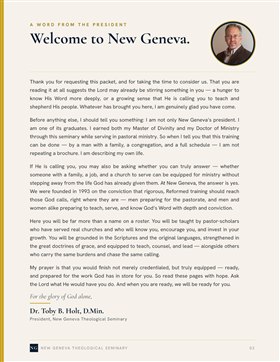
About The Speaker: Dr. Toby Holt serves as the third President of New Geneva Theological Seminary (Colorado Springs, CO), founded 1993. An expository preacher with over 1.9 million sermon downloads on SermonAudio.com, Dr. Holt brings over 17 years of pastoral experience to his verse-by-verse Bible teaching. New Geneva offers Reformed theological education — the M.Div., Th.M., MACM, and Certificate of Biblical Studies, taught live online. For the Doctor of Ministry, contact the registrar about schedule and format.
Sermon Transcript
Summary. In this expository sermon on Acts 20:27, Dr. Toby Holt of New Geneva Theological Seminary teaches that faithful ministry means declaring the whole counsel of God, holding nothing back, just as the Apostle Paul did before the Ephesian elders at Miletus. Preaching from Paul's farewell address, Holt shows that Christ's church is built and guarded by elders who redeem their finite time, sacrifice themselves for the flock, and stand against the savage wolves and heretical words that assault the gospel. The sermon calls every officer and believer to give their limited time to the glory of God and to teach the entire counsel of Scripture.
Paul's Farewell to the Ephesian Elders at Miletus
In Acts 20, the Apostle Paul invited a number of elders to meet with him. However, this would be the last time they would see him alive. You see, Paul was headed to Jerusalem, where he would be thrown into prison. So what did he say in this final encounter?
What encouragement and instruction did he offer? That'll be the focus of today's study.
Continue reading the full transcript 33-minute read · 14 sections · every section links back to the audio
The Stewardship of Finite Time: The Hourglass
You know, there was an older elder once who gave a younger elder just a really unique gift. Specifically, the older elder gave to the younger elder a bronze hourglass. And you know what an hourglass is, right? On one end of the hourglass, in one bulb, there is a collection of sand.
And when you tip it on its end, that sand drains through a very narrow pipeline down to the bottom. And depending on whether the hourglass has been calibrated perfectly, it will take roughly an hour for the sand to drain from the top to the bottom. So that's what an hourglass is. And yet, why would you give it to someone?
If you're an older elder and you've got a younger elder, why would you give an hourglass to anybody? It's an odd thing. You'd think you would have given them some Bible commentaries, something like that. Well, here's the thing.
It wasn't necessarily because it was a great utility in owning an hourglass. Rather, it was because of what the hourglass represented. An hourglass, if you just watch it, it's kind of mesmerizing. You see all the sand at the top, and you watch.
And you watch it go down grain by grain into the bottom. And you know that in time, all of what's up here is going to be down there. In time, everything in the top is going to be in the bottom. And giving this hourglass to the younger elder, the older man wanted the younger man to remember that time is finite, and that the time we have to do the things we've been called to do, we have less of it today than we had yesterday.
And it doesn't matter how old you are in the room right now. You have less time to be the person God has called you to be, to do the things God has called you to do today than you did yesterday. On the plus side, you have more time than you'll have tomorrow. That was the message.
That was what the older elder was trying to impress upon the younger elder.
Redeeming the Time: Paul's Doctrine of the Days
“See then that you walk circumspectly, not as fools but as wise, redeeming the time, because the days are evil.”
— Ephesians 5:15-16 (NKJV)
Now, the Apostle Paul did this a lot, too. Apostle Paul talked about time regularly. If you look in his epistles, you see that time was important to Paul. In Romans 13, Paul said this to the church in Rome.
He said, It's high time. It's high time to awake out of our sleep. For now our salvation is nearer than when we first believed. The night is far spent.
The day is at hand. Therefore, let us cast off the works of darkness. Let us put on the armor of light. So Paul's telling the church of Rome that the night's basically gone.
The day has come, and in their day, when the lifespan, life expectancy was a lot less than it is now, he was talking, everyone who read his letter, he was talking to them, and they knew it. The night is far past. The day has come. Now is the time.
Now is the season to do that which we've been commissioned to do. In Ephesians 5, Paul said this to the church in Ephesus. Look carefully how you walk, not as unwise, but as wise, making the best use of your time, because the days are evil. I could cherry pick a whole host of verses.
You can do it on your own. Just seeing where Paul speaks to time and specifically talks about it as a resource not to be wasted, which is our great sin. But it's a resource not to be wasted. It's worth its weight in gold.
Chains and Tribulation: Paul's Foreknown Suffering
Now, Paul in his own life, he knew that his time was running out. So Paul was probably really sensitive to this, because he's kind of like if a doctor calls you up and says you have yea many days, weeks, months, years to live, suddenly then that amount of time means the world to you.
Well, here's the thing. God had told Paul that his time was limited. Paul knew his time was limited in two ways. Number one, he looked at his gray hair.
He looked at his joints. He felt himself getting a little bit older. That's one way. That's a way we should all be familiar with.
It's a way I'm increasingly more familiar with. So that's one way in which we understand our mortality and start to value time more and more and more and more. But here's the other thing that God did to Paul. God told Paul that your time is limited.
You're going to go to Jerusalem, and you know what awaits you there? Chains and tribulation. God had been kind to Paul in telling him that his hourglass, that the sand had far passed. And because of that, Paul woke up every day saying, all right, how do I use my time?
The days are evil. God is light. How am I going to glorify Him given the amount of time I have this day, one day less than I had yesterday? What am I going to do?
Well, even on his travels, Paul uses his time well. In today's text, the Apostle Paul is on a layover. You've been on layovers on flights? Well, layovers for them were on boats.
They'd stop in ports while those ships, you know, new cargo and stuff and things to go up and down different port cities. Paul is on layover in a city called Miletus. He's traveling towards Jerusalem. The boat has stopped.
And instead of just sitting on the dock of the bay, wasting time, instead of just sitting there, what does he do? Well, he says, I got some time. Hey, Ephesus, call the elders, have them come and let's talk. Let's use this time.
I may never see these guys again. Let's use this time wisely. And so today's text, that's just what he does. He says, come to visit.
And so they do. And here in Acts 20, you get the closest block of text that resembles all the letters he wrote later, a teaching mechanism by which he instructs a local church on how they are to operate in the days yet to come.
The Plurality of Elders: Presbyterian Church Government
All right, let me return to verses 17 through 23. And as we always do, we'll just work our way through the text. Verse 17. So from Miletus, which is where he was having this layover, he sent to Ephesus and he called for the elders of the church.
Hear the word elders. We're going to return to that in a moment. And when they had come to them, he said to them, you know, you know, because I was with you, you know, from the first day that I came to Asia, in what manner I lived among you, serving the Lord with humility, with many tears and with trials that happened to me by the plotting of the Jews, how I kept back nothing that was helpful, but I proclaimed it to you.
And I taught you publicly from house to house, testifying to Jews and also to Greeks, repentance towards God and faith towards our Lord Jesus Christ. Now, see, I go bound in the Spirit to Jerusalem, not knowing the things that will happen to me there, except that the Holy Spirit testifies in every city, telling me that chains and tribulations await me.
All right, who does Paul send for in verse 17? Who does he send for? The, the elders. Now, that, don't just skip past that.
We're inclined, you know, we're good Presbyterians, we read that, we just kind of move on. But that word should stand out for us. Why? Well, note here, when he thinks about what's going on in Ephesus, the church there, he doesn't say, send us the pope, send us the vicar, send us the priest, you know, send us the cardinal, send us the bishop, send us the monk, send us the televangelist, send us the teletubbie, send us any of these different guys.
What does he do? He says instead, you send me the elders. He didn't even ask for the pastor, right? He doesn't talk about, send the pastor of Ephesus to come out.
Why? Because the elders, there was a parity and plurality of this office. When he sends for the elders, he's sending for those that God has ordained to this role as a group collectively to come to him, not just one guy, and certainly none of the other titles that other modern churches have assigned to these roles.
He sends for the elders of the local church. If you didn't know better, you'd think the Ephesians were Presbyterian. I'm just going to leave that right there. So verse 17 says this group, whatever their ecclesiology was, they're governed by a group of elders, and that's a model that you see over and over in Acts and in Paul's epistles.
Persecution in Ministry and Setting the Face Like Flint
Look for that word elders. All right, so what did Paul say to the elders when they arrived? Well, in verses 18 through 21 he reminded them of the time he'd already spent with him. This was not new people he was meeting.
These were people who knew him and that he knew. And so he reminds them of the time they spent together. They talked, they commiserated a little bit about the tears and the trials and the hardships and the plots that had been formed against him, many by the Jews in the local community. See, Ephesus, it was the same as he faced in Galatia and in Corinth and Thessalonica and elsewhere.
Paul would go and sow the gospel seeds and then he'd leave, and then almost immediately other people would come in and sow different seeds or throw shade on the seeds he had sowed or throw shade on him. This was the narrative over and over and over. Those of you who studied the books of 1st and 2nd Corinthians in our Sunday school class during the fall, you saw this.
He was constantly dealing with this sort of thing. Everywhere that he went, either the pagans in the community, like Ephesus, you know, their Diana worship and the like, either the pagans were out to get him or the Jews who followed him from place to place or the Judaizers. These groups came at him in different ways.
He was constantly dealing with this. He dealt with persecution everywhere that he went. And the people in Ephesus had seen this. Ephesian elders had seen Paul's persecution firsthand, and yet they saw that even as it was hard and difficult for him, that he kept preaching the word.
With that said, the persecution was about to get a lot worse, a lot worse for Paul, because Paul says, guys, fellas, you saw how it was in Ephesus. What do you think they're going to do in Jerusalem? If the Jews were plotting to get me in Ephesus, outside of Israel, what do you think they're going to do when I march right into the holy city, right into Jerusalem?
What's going to happen? Paul says, I know what's going to happen, chains and tribulation. I know what's going to happen. Now, if you're one of these Ephesian elders, what's your advice to Paul?
You're going to go to the place where they're going to do this and you know they're going to do it ahead of time? Paul, let's talk. Come back to Ephesus. Go to any number of the places where you have friends where that's not going to happen.
So that had to be some of their encouragement. But here's the thing. Paul had set his face like flint to go to the city, even knowing what awaited him there. Who does that remind you of?
The answer is always Jesus. Jesus, Jesus, Jesus, Jesus. That's exactly what Jesus did. Jesus knew what awaited for Him in Jerusalem.
He knew the chains and the tribulations and the persecution. He even knew the death that would face Him. Jesus knew, but His face like flint, and that's where He went. He went straight into the city.
How could Paul do anything less? So Paul was not to be dissuaded because he knew the necessity and the urgency by which he must go. And he was making haste to get there, which is fascinating. If you knew you had to go someplace where someone was laying wait to kill you, how fast would you be to get there?
Well, Paul was even skipping cities to try, to try, to get to Jerusalem with some speed.
Finishing the Race: The Whole Counsel of God Declared
“For I have not shunned to declare to you the whole counsel of God.”
— Acts 20:27 (NKJV)
All right, let's look at verses 24 to 28. But none of these things move me. In other words, I'm not afraid of this stuff. None of these things move me, nor do I count my life dear to myself so that I may finish my race with joy.
I'm not a masochist, Paul would say. I don't want pain, but none of these things move me, nor do I count my own life dear to myself because I want to finish my race. Finish my race with joy in the ministry which I have received from the Lord Jesus to testify to the gospel of the grace of God.
And indeed, verse 25, Indeed, now I know that you all, among whom I have gone preaching the kingdom of God, you will see my face no more. Therefore I testify to you this day that I am innocent of the blood of all men, For I have not shunned to declare to you the counsel of God, the whole counsel of God.
Shepherding the Church Purchased with Christ's Blood
“Therefore take heed to yourselves and to all the flock, among which the Holy Spirit has made you overseers, to shepherd the church of God which He purchased with His own blood.”
— Acts 20:28 (NKJV)
Therefore, take heed yourselves, and to all the flock among whom the Holy Spirit has made you overseers, to shepherd, shepherd the church of God which you purchased with His own blood.
Living to Glorify God, Not Self
Let me ask you, just as Christians, do you exist to serve God? Do you exist to serve God or to serve yourself? Now, you don't have to answer, but you know, you know that you exist to glorify the one who made you. You know it.
But what happens is, on any given day, week, year, decade, we take Him and we make Him a satellite in orbit of us. And our decisions bring ourselves glory, or they're geared towards our own views and wants and whims and the like, and God remains, at times, just over here to our periphery.
But Paul says, that's not me. God's not there with me here. He's not a satellite in orbit of me. I center around Him.
And that's why I go, Ephesian elders. How can I do any less? I don't count my own life dear to myself. Again, he wasn't a masochist.
This isn't a guy who wanted the sort of suffering he was going to endure. He hated the trials and tears he'd already been through. Dear heavens, any time he writes about trials and tears, it's not like, oh, goody, more of that. Instead, he always looks back and says, that was terrible.
I hated it. But there's probably more of it, because that's the nature of living in a fallen world and evil days. So he says, I go. I go to Jerusalem.
Now, God probably has not sent you to Jerusalem, but he sent you to Gulfport, he sent you to people in your own family, he sent you to people in your vocation, people just down the street. He sent you also to be an ambassador. The challenge is, the challenge is, and sometimes we just don't recognize that, A, and B, sometimes His priorities aren't ours.
So He tells us to go, and we say, in a bit, in a bit. We've not got these other things taken care of. God says, go, and we say, ah, ah, ah, ah. How about tomorrow work?
Paul, that's not his approach. Now, the Ephesians knew his approach firsthand because he had spent three years in their midst ministering to them, and they had watched him sacrifice his welfare over and over again for their benefit. They also knew, something else he said here, they also knew that just as he sacrificed his life for their sake and for the glory of their mutual maker, he also, when he had talked to them, when he taught them and preached and taught and all this sort of stuff, he had not withheld things that they needed.
Rather, he preached to them the whole counsel of God. Now, that can't have been easy. Paul, if he was to preach and teach what God hath said, there was two groups that were waiting on every word, every word, ready to nail him. Now, one group was the pagans.
The locals there were waiting for any offense against their local deities and any offense to the cultural norms of Ephesus or Corinth or what have you. So there's always pagans waiting for him to mess up. But there was also the Jews in every context waiting for him to offend the law or Moses or any of the things that they rightly cherished.
But remember, they denied the application of Christ in the gospel to those things. With that said, there was people, every word he said, every word out of his mouth, they were ready to nail him. And yet, despite looking out at folks who were staring daggers back at him in many cases, in many of the places he went, he says, I have not.
I have not withheld one word that you needed. I've not withheld the whole counsel of God. And the elders had seen that. And the idea here is that they were to go do likewise.
Paul would never see them again. He would never see the people that they ministered to again. He would never see the flock in Ephesus again, but they would. And so the idea was that just as Paul had preached the whole counsel of God, that they would go back to Ephesus and do the same thing.
Ready to stand in the evil hour. Well, here's the thing. The evil hour, it was right around the corner.
Savage Wolves: Threats to the Flock from Within and Without
Let's look at the next verses. Verses 29 through 31. Verse 29. And you can almost hear the scary music starting to play.
Verse 29. For I know, I know this, that after my departure, savage wolves will come in among you, not sparing the flock. Also, for among yourselves, for among yourselves men will rise up speaking perverse things to draw away disciples after themselves. Therefore watch and remember that for three years I did not cease to warn everyone night and day with tears.
All right, let's say that when worship ends here, let's say you get in your car and you head back to the house, but let's say that while you've been gone this morning, someone has entered your house and let a pack of savage wolves on in, and they're running around, they're eating your Cheetos and Ho Hos and what have you, they're making a mess of everything, and they're ready, if you come in that door, to make a snack of you.
Let's say that that reality. Now, if you knew that, if someone warned you and said this is what's going to happen when you go back, would you enter your house with some trepidation? I assume so. If you knew for certainty that it was going to happen, would you be armed?
Would you want the militia, the wildlife control, all the guns and ammo you could have to help deal with the savage wolves that were ready to devour you and your children? Well, yes, you'd want to be on your guard. Well, in verse 29, Paul is not talking about real wolves per se, but he's saying that the same sort of threat and danger, danger, Will Robinson, the same threat and danger that you might face going home and facing real wolves in your own house was headed to the church.
And not just some other church somewhere down the street, you know, those heretics way down there. He says, your church in Ephesus. He says, I know what's going to happen after I depart. Savage wolves are going to come in, and they're just going to rip the flock apart.
Now, real wolves, real wolves, what do they use? They use claws and fangs and teeth, but that's not the nature of the attack that the Ephesians would have in their own congregation. The nature of the attack would be somewhat different. The wolves that would be in Ephesus would not have fangs and teeth and the like.
The Serpent's Weapon: Attack by Words in Eden
They would have words. In the Garden of Eden, we've said this before, but in the Garden of Eden, you have Eve. The snake comes on in. What does the snake do?
Does the snake sink fangs into her neck as part of the means to attack? Does it constrict around her neck to try to kill her? No, no. What does the snake do? He speaks, and words come out.
And I assure you this, you can do far more damage with one book than you can one gun. You can do far more damage with one sentence than one gun or one sword or what have you. We know that because in the Garden of Eden, what the devil asked Eve, three words, hath God said?
Did God really say, really say what you think He said? And did He really mean what He said and the way that you understand it? No, Eve, you're confused, but let me explain it to you. Come over here.
Let's talk. The devil didn't use fangs and constriction to harm and maim and really to fundamentally destroy the human race, or at the very least to bring death in. He didn't do that. He just used words, and that's what was going to happen in Ephesus.
There wasn't going to be fangs and teeth and claw marks going on. There were going to be words, words that would be used to cause harm in the midst of the local body. That's what he's talking about.
Heresy and the Drawing Away of Disciples
In verse 30, he says, men will rise up speaking perverse things. Now, what kind of perverse things is he talking about here? Well, on the one hand, this may be a reference to overt heresy. In fact, it probably is.
It may be a reference to overt heresy. What was probably going to happen in this context is that wolves are going to come in and they're going to do what they had done in Galatia and other places. The wolves are going to come in and say things that contradicted the gospel that had been given to them through Paul and other godly men.
There were going to be some who were going to come in and even rise up from their midst who were going to start saying things about Jesus, His nature, His work, all that stuff that was not going to jive with what Paul and others had said. Again, this happened really everywhere that Paul had went.
He'd seen it. He could say, take it to the bank. It's going to happen. Men are going to rise up and they're going to have these heresies, undermine the gospel or which contradict the faith.
So what he may have been talking about were savage wolves that would come in that were heretical, and that's probably the case. With that said, notice in verse 30, what's their motivation for doing so? Is it just because these guys say, I like me some bad theology, I'm going to start spreading that around?
Is that it? No. What does it say in verse 30? What's their motivation for doing what they do? To draw away disciples after themselves.
What does this suggest? Well, it suggests that not only were they going to say false things, but self-serving things. Not everything that happens in a church or every wolf in the church is focused on bad theology. Sometimes it's a coalition.
And that's what he says is going to happen. They're going to look to splinter. And Paul had seen that. You know, there was churches he went to where some people were following Apollos or Barnabas or Paul himself or what have you.
He says, no, it's all about Jesus. Let's just follow Jesus. How about that, guys? That's really Paul's approach.
But he had seen elsewhere that people just weren't following that plot line. In Corinth, again, we mentioned this in our Sunday school class this fall. Remember, Paul talked about a group of some guys who came up in Corinth and he referred to them as what? The super, super apostles.
He talked to them in Corinth about these super apostles, and it wasn't because they were very strong and burly or they were extra powerful apostles. It was individuals in Corinth who had taken it upon themselves to see themselves as greater than those who had been with Jesus and certainly greater than Paul himself.
He had seen this and so he refers to these men as the super apostles. Well here in Ephesus, he's talking about the same sort of thing. And it's not just Paul who talks about this. Read Peter, read Jude, read the words of Jesus.
This was a repeated issue.
The Sacrificial Office: Giving of Time and Self
All right, with that said, let's look at verses 32 through 35. So now, brethren, I commend you to God and to the word of His grace, which is able to build you up and give you an inheritance among those who are being sanctified. I've coveted no one's silver, no gold, nor apparel. Yes, you yourselves know that these hands have provided for my necessities and for those who are with me.
I've shown you in every way by laboring like this that you must support the weak and remember the word of the Lord Jesus that He said, it's more blessed to give than to receive. All right, so in verses 32 through 35, Paul did something that's very reasonable for an apostle and a leader of God's people to do.
He says, look here. Paul says, it's not just things I said, but you saw how I came alongside you. But he says, when others come into the church, come alongside them in the same way, giving of yourself. See, one of the main things, he warned them, of course, to be on the lookout for these heretics.
So he warns them about that. But he transitions. That's not even his primary focus there. His primary focus is to tell the guys, hey, remember, remember that if God has appointed and called you to church office, that it's a sacrificial office.
This is valid for those gentlemen who are going to be ordained and installed today and next Sunday. It's an office of sacrifice. And Paul says, look at me. It's been a sacrificial ministry, and you all have seen that.
And he wants, he expects the Ephesian elders to give of themselves. Now, let me ask you a question. In most church contexts, when we talk about giving of ourselves, and we're talking about it's more blessed to give than receive and all that sort of stuff, we tend to think of, I don't know, money, finances, physical things and the like.
We tend to think along those lines. With that said, do you know what the number one thing, the number one thing our church elders, our deacons, our staff, our teachers, our leaders, our many volunteers, do you know the number one thing that they give? Do you know what it is? Time.
The number one thing, the number one thing that is given from God's people to other God's people in our context is time. In teaching Sunday school, in coordinating VBS, in all the ways in which we look after the well-being of people from small to tall, the number one thing we're giving of ourselves as we do so is our time.
And so Paul reminded the people in Ephesus, that's what I gave you. I gave you three years of my life. It's not just what I did. I gave you my life.
The grains of sand, the grains of sand, they're finite. They're always finite. I give you three years of them because I love you. When you see all the wonderful service that goes on in our church, when you see all the people doing wonderful things on Wednesday nights, the level of efforts that go into everything that happens on Wednesday nights, when you see the choir's preparation, hear all that they do, when you look at the way children are educated in the education wing, Wednesdays and Sundays and all sorts of other avenues, when you look and see all this, think of the grains of sand that are dropping, but they're worth gold.
We tend to think it's a sad thing. I have less time than I had yesterday. But what if you use that time well? What if you use that time well?
How cool is that then? Don't be sad about how much time is left up here. Look at the basin. Look at the bulb and ask, how was this used?
Now, for many of us, myself included, you look at how it was used, and you say, it's not used the way I think I would have wanted it to. There's some gold in there, but not as much as I would have liked to offer. Well, here's the thing. What Paul would say elsewhere is he'd say, I don't look back, but I look forward.
I keep pressing forward. The upward call in Christ Jesus. He talks about a race that he didn't run past tense, but he continues to run. Today, you have the opportunity to look at the sand at the top, the grains of sand.
They're each worth, potentially, each worth gold. And I ask, how am I going to utilize this for the glory of God and for the people of the kingdom? Well, you know Paul's answer, because that's what he's trying to tell them. He says, you know what I did, and you know why I did it, and you know why I'll go to Jerusalem and do the same thing, because I love God and I love His people.
And I'll do my best to use my time for His benefit. I'll pour out my life, he'll say in Timothy, I'll pour out my life like a drink offering, because that's what it is. And so is yours. When we're young, really, we don't understand that.
As we get older, we start to understand it more and more.
Links in a Chain: Christ Building His Church Across Generations
All right, let's look at our final verses, verses 36 to 38. Verse 36. When he had said these things, he knelt down and he prayed with them all. Then they all wept freely, and they fell on Paul's neck and they kissed him, sorrowing most of all for the words which he spoke, that they would see his face no more.
Then they accompanied him to the ship. You know, not everyone was sad to see Paul go. The Apostle Paul was a polarizing guy. If Paul was to walk down the street, half the people would want to hug him and half the people would want to kill him.
In fact, that was a reality in his day-to-day life. The ratio was probably even worse than that in some places. And it wasn't, the people were upset with Paul. It wasn't necessarily because of the things he did.
I mean, Paul was a sweetheart of a man. You look what he did. He says, I didn't covet. I didn't take your stuff.
I was over here tent-making, trying to take care of you, offering you my life, doing all this, you know, staying up to all hours of the night, preaching, teaching to anyone who would hear. I gave you myself. It wasn't the things he did that angered people. It wasn't the things he did that made people want to chase him down.
It was the things that he said. And so, so often he had folks that were antagonistic toward him. Which really, that's not unusual. Look at the prophets.
Dear heavens, prophets are always being chased around. The ratio was even probably far worse for most of them. They're always being chased around by those who didn't like what they said. Even as they might have been great guys, those are the things they said that angered the people who heard.
But notice here, notice in these last verses, in verses 36-38, that that was not the case of these elders in Ephesus. They didn't hate Paul for what he said. They loved him for what he had said, and the words he said about that he would be departed made them sorrowful. These men had served in the trenches.
There's a special bonding that comes with serving in the trenches with others. They had co-labored in the gospel. They had served at Paul's side, and the very words that had angered so many and polarized people, even in their community, had encouraged them and had emboldened them. And so the prospect of parting with him, it broke their hearts.
That's what we see. Verse 37, these men, and I'm sure they were manly men, but these men, they wept freely. But the apostle Paul had given them that which God had called him to give. He'd given them as many grains of sand as he possibly could.
And now it was time to walk him to his boat, which is what we see in verse 38. That had to be hard. But here's the thing. If you were an elder in Ephesus, it was hard to see Paul go.
But the future of your church in Ephesus didn't hinge on him. It hinged on Christ, who's the head of the church. It hinged on Christ. And yes, Paul was gone, and that was sad.
But Jesus hadn't gone anywhere in the sense that God was with him. And in time, in a very short time, God would send others to minister in Ephesus. Do you know one of the men he sent to Ephesus? A man named John.
John spent a lot of time in Ephesus. There was others, too. And not only did they spend time in Ephesus on God's behalf, but these men grew. These officers grew in their ministry.
They were all links in a chain. Even Paul was just a link in a chain. And for the officers that are to be ordained and installed this morning, the same is true of you and I. We're links in a chain. We just are.
But God holds every strand of it. And even as Paul departed, God had great things in store, at least in the near term, for the church in Ephesus. Now I'll ask you a question as we look to close this morning. I'll ask you a question I asked on Wednesday night of folks who were gathered for Dr. Iverson's ordination.
This church, how old do you think it is? February, 125 years. We're talking about maybe some ways we can celebrate that, but 125 years. Dear heavens, the oldest person in our midst is still a babe in that span of time, 125 years.
How fascinating is it to think that at one time, 10 pastors ago, hundreds of elders ago, at one time, God raised up a core group to plant a church, the first church of Presbyterian ecclesiology in Gulfport, which we know because it's called First Presbyterian. But he raised up these individuals at that time in order to accomplish this task.
And at that time, 125 years ago, elders were appointed. Now, do you know what they've been doing for 125 years since? Every time when officers were ordained into ministry, others came and placed their hands on them. Officers were elected and ordained within the congregation going back 125 years.
So today, when you see hands being placed on a man, think about this. Other hands were placed on them too, and other hands were placed on those who placed their hands on them, going as far back as 125 years. God is in the business of building His church. He's in the business of building His church on the whole counsel of God, and the charge for every officer in this church, and really every man, woman, and child, is that we would not steer away from this, but we would focus on this.
And if we want to be another 125 years, it's going to come from teaching everything that is within this book's pages. Let's pray.
More in The Book Of Acts
Continue the verse-by-verse series.
Keep listening — every sermon is free.
160+ expository sermons with full transcripts, across 14 books of the Bible.