Introduction to Reformed Theology
Explore the doctrines of grace, Calvinism, systematics, and more.
Auditors are welcome to join at any point in the term — every session is recorded, so nothing is lost by starting late.
The Doctrines of Grace, Systematized
What do we believe, and why? This course introduces theology proper and its many derivatives — Christology, eschatology, and more — helping you form a cohesive framework around the doctrines of grace.
You'll see how systematics organizes biblical truth into a consistent whole, giving you a fuller grasp of Scripture — and you'll be equipped to articulate and defend your faith with clarity, resting on the absolute authority of God's Word.
What You'll Study
You'll come away able to see how systematic theology gathers the whole of Scripture into one coherent framework centered on the doctrines of grace, and to articulate and defend your faith with clarity, resting on the final authority of God's Word — beginning with three foundations:

Historical Calvinism
Walk through the "Five Points" to see how salvation is entirely a work of God's sovereign grace, from beginning to end.

Sola Scriptura
Explore why the Bible is the final, supreme authority for what we believe — free from the shifting winds of human tradition.

Covenant Theology
See the Bible as one unified, redemptive story, tracing God's gracious promises from Genesis all the way through Revelation.
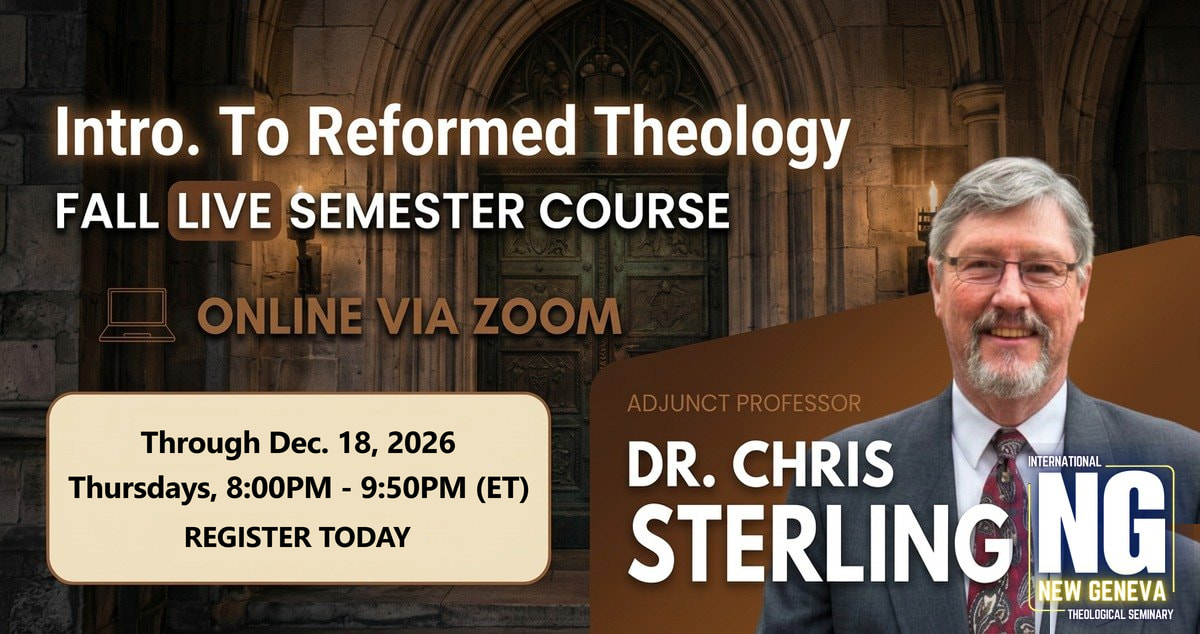
Taught by Dr. Christopher Sterling

Dr. Sterling is a retired Army chaplain who planted and pastored Westminster Fellowship in Falcon, Colorado (now High Plains Fellowship, PCA), from 2008 to 2013. He has served as an interim pastor for churches in the PCA's Rocky Mountain Presbytery and sits on the Presbytery's Credentials committee.
Logistics
Frequently Asked Questions
No. Introduction to Reformed Theology is a foundational course with no prerequisites — open to anyone who wants to understand the doctrines of grace, whether you're pursuing a degree, auditing for enrichment, or exploring seminary study.
Yes. Your first New Geneva course is free to audit, so you can sit in on ST 501 Introduction to Reformed Theology at no cost. Auditors attend every live session and join the discussion, with no assignments, exams, or academic credit. The full audit policy is on the courses page.
Classes meet live on Thursday evenings from 8:00 to 9:50 PM Eastern across the fall semester (August 31 – December 18, 2026), online via Zoom — so you can join from wherever you are. Dr. Sterling emails the Zoom link to everyone signed up for ST 501.
One book is required: Robert Reymond's A New Systematic Theology of the Christian Faith, 2nd edition — all the reading assignments are chapters in it, so get that edition. Louis Berkhof's Systematic Theology and John Calvin's Institutes of the Christian Religion are recommended, not required. Full details are in the syllabus.
Audit or Take for Credit
Join the class this term — audit along for enrichment, or enroll for credit toward your degree. Auditors may join at any point in the term; the recordings are on the class page from the first evening onward.
Audit the Course
Your first New Geneva course is free to audit.
- Attend every live class and join the discussion
- No assignments, papers, or exams
- Learn from the same lectures as credit students
- No application, transcripts, or references needed
- No formal academic credit awarded
Take for Credit
- Earn 2 credit hours toward a New Geneva degree
- Assignments, readings & graded feedback
- Full participation in the live weekly class
- No prerequisites required
Sit In On This Class
Come as a guest to the live Zoom sessions and listen in — no application, no assignments, no exams.
Your first New Geneva course is free to audit. Sessions meet Thursdays, 8:00–9:50 PM ET, and every session’s recording will be available on demand.
We’ll send you a Welcome note and Zoom link.
Prefer to talk first? Book a free 15-minute call with our registrar.
Take for Credit
Earn two credit hours toward your New Geneva degree. Share your details and our registrar will guide you through enrollment for this term.
New to New Geneva? You'll complete a short application — we'll walk you through it.