How Does the Book of Genesis End?
Jacob's last words point to a people, a promise, a King.

About This Sermon
Genesis began in a garden, with God pronouncing blessing over everything He had made. It ends in a coffin, in Egypt — and the last voice we hear is Joseph's, speaking of a God whose purposes outlast every grave. In this closing sermon of the Genesis series, Dr. Toby Holt examines the prophetic blessings Jacob spoke over his twelve sons on his deathbed, what the blessing of Judah in Genesis 49:10 reveals about a coming ruler from that line, and why Joseph's final instruction — "God will surely visit you, and you shall carry up my bones from here" — is itself an act of faith in a God who does not abandon the story halfway through.
Sermon Chapters
Select a chapter to play the audio from that moment, or “Read” to jump to that part of the transcript below.
Questions This Sermon Answers
Genesis 49 records Jacob blessing each of his twelve sons with prophetic words about their tribal futures. Some blessings were positive (Judah, Joseph), others were warnings (Reuben's instability, Simeon and Levi's violence). The blessings were not merely fatherly affections — they were prophetic declarations about the character and destiny of Israel's twelve tribes. They were fulfilled across Israel's history: Levi became the priestly tribe, Judah the royal tribe, Joseph's descendants (Ephraim and Manasseh) became the most prosperous northern tribes.
Genesis 49:10 is the most important messianic prophecy in Genesis: "The scepter shall not depart from Judah, nor a lawgiver from between his feet, until Shiloh comes; and to Him shall be the obedience of the peoples." The scepter represents royal authority; the promise is that it will remain in Judah's line until "Shiloh" — understood across the Reformed tradition as a messianic title — comes. The New Testament's fulfillment is explicit: Jesus was of the tribe of Judah (Matthew 1:2-3; Hebrews 7:14; Revelation 5:5 — "the Lion of the tribe of Judah"). The entire royal-messianic trajectory of the Old Testament begins with Jacob's deathbed words.
Genesis 49:29-33 records Jacob's insistence on burial in the cave of Machpelah in Canaan, where Abraham, Sarah, Isaac, Rebekah, and Leah were buried. The request was an act of faith — a declaration that Egypt, for all its power and provision, was not home. The Promised Land was home. Hebrews 11:13-16 interprets the patriarchs' entire orientation as confessing "that they were strangers and exiles on the earth... they desire a better country, that is, a heavenly one." Jacob's bones in the cave of Machpelah were his most eloquent sermon: I belong to the land God promised, not to the world that fed me.
Genesis 50:25 records Joseph's oath: "God will surely visit you, and you shall carry up my bones from here." This is the last act of the last patriarch in the book of Genesis — an act of faith pointing forward. Hebrews 11:22: "By faith Joseph, when dying, made mention of the exodus of the children of Israel and gave directions concerning his bones." Joseph believed God would fulfill the promise to Abraham — that Israel would return to Canaan. He wanted his bones to make that journey. Exodus 13:19 records Moses faithfully carrying Joseph's bones out of Egypt. Joshua 24:32 records their burial in the Promised Land.
The phrase translated "visit" (Hebrew: paqad) means God's active, purposeful intervention in history — an appearing to accomplish what He has promised. Joseph used the same phrase that God would use to Moses at the burning bush: "I have surely visited you" (Exodus 3:16). The repetition is deliberate: Genesis ends with Joseph's faith-declaration of a future divine visitation, and Exodus opens with that visitation beginning. The last words of Genesis point directly to the first words of the next chapter in God's redemptive story. The promises do not end with Joseph's death — they accelerate.
Genesis ends with Israel in Egypt — numerous, prosperous, fed by Joseph's position, but not in the Promised Land. The stage is set for the next act: oppression, multiplication, divine visitation, and exodus. Genesis establishes all the foundational categories that Exodus will dramatize: the covenant promises (land, seed, blessing), the pattern of election and grace, the failure of human effort to accomplish what God alone can do, and the certainty of God's faithfulness despite every obstacle. Genesis is the prologue; Exodus is act one. The whole Bible is the story of how God brings His people home.
Genesis answers the most basic theological questions: Who is God? (The self-existent Creator, covenant-maker, sovereign over all history.) Who are we? (Image-bearers, fallen, dependent on grace.) What went wrong? (The Fall — human rebellion against divine order.) What is God doing about it? (Calling a people through sovereign grace — from Abraham to Joseph — through whom all nations will be blessed.) How does it end? (The promise is certain: God will visit His people, the land will be theirs, and from the tribe of Judah will come the One to whom "shall be the obedience of the peoples.") Genesis poses the question that the rest of the Bible answers: who is the promised seed?
The final verse of Genesis — "Joseph... was embalmed and placed in a coffin in Egypt" (50:26) — seems like an ending. But it is a cliffhanger. The greatest story of redemption ever told does not end with a coffin in Egypt. It ends with a promise: God will visit, the bones will be carried out, the scepter will not depart from Judah. Every reader who has followed the story from Eden to Egypt knows that the promise is still outstanding. The seed of the woman who will crush the serpent (Genesis 3:15) has not yet come. The son of Abraham through whom all nations will be blessed (Genesis 12:3) has not yet been born in Bethlehem. Genesis is incomplete by design. Its last word is a coffin; the Bible's last word is a resurrection.
Key Theological Points
1. The Messianic Promise Through Judah
Genesis 49:10 is the foundational Old Testament prophecy of a royal Messiah from the tribe of Judah. Westminster Confession 8.1 states that "it pleased God, in His eternal purpose, to choose and ordain the Lord Jesus... the only Mediator between God and man, the Prophet, Priest, and King." The trajectory from Genesis 49:10 to Revelation 5:5 ("the Lion of the tribe of Judah") is the Old Testament's longest royal thread — stretching from Jacob's deathbed through David's dynasty to the eternal throne of Christ. The scepter that Jacob promised has been in Judah's line from David's anointing to the Lamb's exaltation.
2. Faith That Looks Forward
Both Jacob's insistence on burial in Canaan and Joseph's request that his bones be carried out of Egypt are described in Hebrews 11 as acts of faith — faith that looked beyond the present reality to the promised future. Hebrews 11:1: "Faith is the substance of things hoped for, the evidence of things not seen." Both patriarchs were asking to be buried in a land they did not currently possess, confident that God would give it to their descendants. This is the posture of Christian eschatology: we live in Egypt (this world), we belong to Canaan (the new earth), and we orient our lives accordingly. The bones of Joseph in Egypt were a sermon: this is not where the story ends.
3. The Unity of the Biblical Narrative
Genesis 50:25 — "God will surely visit you, and you shall carry up my bones from here" — links directly to Exodus 3:16 — "I have surely visited you." The same word, the same promise, the same God. The Bible's narrative is not a collection of independent stories — it is one story with one Author moving toward one end. Calvin writes: "Scripture is its own interpreter." The last words of Genesis are only fully intelligible in light of Exodus; Exodus is only fully intelligible in light of the rest of the Pentateuch; and all of it is only fully intelligible in light of Christ. The bones of Joseph are the Bible's statement that the story is not over until the promise is fulfilled.
4. The Text: Genesis 49:10 and 50:24-25 (NKJV)
"The scepter shall not depart from Judah, nor a lawgiver from between his feet, until Shiloh comes; and to Him shall be the obedience of the people... And Joseph said to his brothers, I am dying; but God will surely visit you, and bring you out of this land to the land of which He swore to Abraham, to Isaac, and to Jacob. Then Joseph took an oath from the children of Israel, saying, God will surely visit you, and you shall carry up my bones from here."
Continue studying: explore the full Book of Genesis sermon series, or browse the complete Reformed Sermon Archive.
About Our Speaker

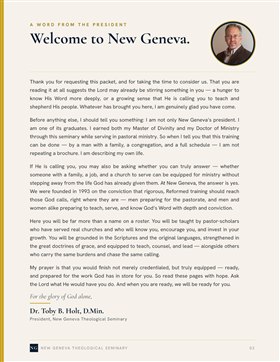
About The Speaker: Dr. Toby Holt serves as the third President of New Geneva Theological Seminary (Colorado Springs, CO), founded 1993. An expository preacher with over 1.9 million sermon downloads on SermonAudio.com, Dr. Holt brings over 17 years of pastoral experience to his verse-by-verse Bible teaching. New Geneva offers Westminster Confessional theological education — the M.Div., Th.M., MACM, and Certificate of Biblical Studies, taught live online. For the Doctor of Ministry, contact the registrar about schedule and format.
Sermon Transcript
Summary. In this sermon on Genesis 49-50, Dr. Toby Holt of New Geneva Theological Seminary teaches that the book of Genesis reveals mankind's total depravity yet magnifies the patience, grace, and sovereign providence of God, who works even human evil for good. Through Joseph's forgiveness of his brothers ('you meant evil against me, but God meant it for good'), Joseph stands as a type of Christ, foreshadowing the God who welcomes returning sinners as sons rather than servants. Genesis ends in a coffin in Egypt, but its final words point forward to God's promise to bring His people home to the promised land.
The End of Genesis: Summarizing the First Book of the Bible
In today's sermon, we come to the end of Genesis, Genesis chapter 50. Throughout this book, we've read about a number of significant events, from creation to the fall, from Noah's Ark to the Tower of Babel. We've also encountered some of the greatest heroes of the faith, including Abraham, Isaac, and Jacob. So what have we learned from the very first book in the Bible?
How can we summarize everything that we've read about so far? That will be the focus of today's study. with creation, remember, it started wonderfully.
Continue reading the full transcript 28-minute read · 15 sections · every section links back to the audio
The Nature of Sin: From Creation to the Fall and Beyond
Everything was going great. If you just stopped at the first, like, two chapters of Genesis, you'd say this is dynamite. Look at this utopia. Look at this nirvana.
And yet it quickly spiraled into the fall, and it didn't stay at the fall, but one chapter after the fall you had a brother slaying another brother. You had Cain killing Abel and the like. And you would think that's got to be the lowest ebb of Genesis. Wrong.
It got worse, far worse, even quicker. If even a few chapters just in from that you have the flood, because virtually all of mankind, with the exception of one man in his family, was deemed unworthy even to draw another breath. The nature of sin and rebellion you see just in the first few chapters is greatly significant, and it continues.
It continues even though you have wonderful events. You have the covenant that God makes with Noah. You have the covenant God makes with Abraham. You see the covenants and the promises and the patriarchs, and you see a lot of good stuff.
Undoubtedly a lot of good stuff. You also see the pockmarks of all this sin. You see the flood and the rebels that were there and the rebels then thereafter at the Tower of Babel. You remember that story.
You remember the people of Sodom and Gomorrah and the nature of their depravity. You remember Jacob, one of the patriarchs, stealing his brother's blessing and lying and fooling his own father. Reuben's incest, we didn't talk about that, but it's one of the dark pages in Genesis. Finally, in the past number of chapters, you have Joseph's brothers.
Joseph's brothers, the patriarchs. You have the 12 tribes, so to speak, just dealing terribly, sinfully, awfully, horrifically with their own brother. If you started this, started Genesis, again, everything's looking really up. Everything's looking really good in the first couple chapters.
God creates this wonderful circumstance by which the federal heads, Adam and Eve, would dwell in. This wonderful circumstance, this utopia, this nirvana. But man alive, things got bad. It started with, in the beginning, God created the heavens and the earth.
Do you want to know what the last verse in the book of Genesis was? We just read it a minute ago. It talks about the coffin in Egypt. The last verse will say, Joseph died, they embalmed him, and he was put in a coffin in Egypt.
The Total Depravity of Man Revealed in Genesis
If you were to stand back from the book of Genesis, you would learn this about man. Man is pretty rough. You would learn this about mankind. That mankind, from them to us, has a lot of rough edges.
And that's the nicest way I can phrase it. You could say it is totally depraved. You could say the thoughts and imaginations of the heart are continually evil. You could say any manner of things like that, and you'd be right.
And you see it throughout the book of Genesis. So mankind, if this is our biography, if this is our backstory, if this is our history, it's not an especially bright history, and it doesn't paint us terribly well. It doesn't put mankind in the greatest light.
The Character of God: Patient, Gracious, and Forbearing
With that said, you know who comes away from Genesis looking great, looking fine, smelling like roses? God Himself. When you look at Genesis, man looks bad. God.
God looks every bit like the perfect and kind and forbearing and merciful and gracious Heavenly Father that He is. And we know that because of how much He put up with.
The Grace of God's Covenant Promises to Sinners
We know that because our story, such as it is, could have ended in Genesis 3, but it didn't. We said before, the two finest words in the whole English language, when you string them together, are the words Genesis 4. Why? Because Genesis 4 reminds us that mankind's story, your story, didn't end in Genesis 3 when you could argue it should have.
In Genesis 3, man did the very thing God told man not to do. He knew the consequences. If the wages of sin is death, then that could have been the end. That's it, and that's all.
God could have said, out of the pool, everyone, and that could have been the end of mankind's story. But because God is patient, because He is gracious, because He is kind, because He is loving, because He is forbearing, because He's all these different things, He allowed, He enabled, He decreed, mankind's story would not end.
And that even though mankind would continue to show the fruit and the root of its corruption, with Cain and Abel just literally one chapter over and on and on through the book of Genesis, God, for His part, would stand back and continually offer grace and mercy and charity and love and compassion and empathy and a promise, a promise to Abraham, who was a sinner like you and I are sinners, a promise to Abraham that even though he was a sinner and although his children would be sinners and all of his grandchildren would be sinners, that God would yet make a great nation out of them, that God would call them out from this fallen hellscape, from this fallen land.
God would call them out to make them a people for Himself, and in due time, they would be holy as He is holy. God made a promise throughout the book of Genesis. He made several promises in the book of Genesis. And at every step and at every interval, He fulfilled them.
Genesis, as man's story, it's rough. But when you stand back and look at the characteristics and the attributes and the actions of God, you can't come away with anything other than His thought. God, You are good. God, You are loving.
God, You are perfect, and man, we need You, not the other way around. All right, this morning my objective is to go through these verses in three chunks and identify how the book wraps up and how it transitions and looks to the future and Egypt and then beyond. All right, let's look at verses 15 through 17 once again as we do so.
Joseph's Brothers Fear Retribution After Jacob's Death
“Now when Joseph's brothers saw that their father was dead, they said, "Perhaps Joseph will hate us, and may actually repay us for all the evil which we did to him.”
— Genesis 50:15 (NKJV)
Verse 15. Now Joseph's brothers saw that their father was dead, they said, perhaps Joseph will now hate us and may actually repay us for all the evil that we did to them. In other words, their fear, their long fear had been that the only reason Joseph's being so nice, the only reason he's forgiven us and brought us to live here, is for his father, because they've always had this thing.
You know, they've had this close relationship. The father, Jacob, has loved Joseph, the son. We don't always get why he loved him as much as he did, but he did. But now he's dead, and now maybe the son will not feel like he's got to do what the father desires him to do.
Now maybe he'll bring out the vengeance. Now maybe the heavy hand of Joseph in Egypt will come down upon us. So when Joseph's brothers saw the father was dead, they said, perhaps Joseph will hate us and he may repay us for the evil that we did to him. And so they sent messengers to Joseph, which is interesting, suggests their discomfort here.
And the messengers said this, before your father died, he commanded saying, thus you shall say to Joseph, I beg of you, please forgive the trespass of your brothers and of their sins for the evil that they did to you. Now, please forgive the trespass of the servants of God of your father. And Joseph wept when they spoke to him.
All right. So as we pick up at verse 15, Joseph's father, Jacob, is dead and buried. That's the end of his story. And as we said, his brothers are anxious that maybe this means that he will now deal with him, that his true colors will now be given an opportunity to shine.
And so what do they do? Well, they send messengers to sort of test the waters, right? They send guys that he was probably not going to kill those guys. And if he did kill those guys, they're not us.
So they sent messengers to Joseph. And interestingly, interestingly, what do the messengers bring? Well, the messengers bring this story. And it may or may not be true.
There's no sign here that it is or that it isn't. But they bring the story. And they said, hey, you know, before your old man died, you should know this. That he commanded, he commanded you to forgive us.
That's what the messengers say. They said, Before your fathers die, verse 16, he commanded, saying, Thus you shall tell Joseph, I beg you, please forgive the trespass of your brothers and their sin, for they did evil to you. So in other words, the brothers there are anxious that the retribution is going to come down.
They send the messengers, and the messengers go and tell the story that the father evidently gave a command from the grave, Thou shalt forgive your brothers. So they tell the messengers to go and tell this to Joseph. Whether Jacob actually said that or not, we do not know, but this is what the brothers and the messengers go tell him.
Whatever the case, Joseph's reaction is what? Well, his reaction, verse 17, is he just weeps. You know, his brothers still don't get him. His brothers never got him when he was a kid, for what it's worth.
That was part of the problem. His brothers didn't get him. They thought he was full of himself. They thought he was all these different things, and maybe he was some of that, but they didn't understand him.
They didn't understand him. Have you ever had a relative, have you ever had a parent, a brother, a sister, a sibling, what have you, that just hasn't got you? Well, in this case they didn't get him, and the very thought, the very idea that he would be so fickle as to play along for several years while they're there in Egypt the whole time, hiding the dagger behind his back, the very idea that they would ever think that he would do that, it hurts, it cuts him to the heart.
It's like, dear heavens, they still don't get it, they still don't know me. If they think I would do that, they still don't get it. And so we see in verse 17 that he weeps.
Guilt, Shame, and the Weight of a Fractured Relationship
Let's look at verse 18. Then, this is the next step, then his brothers went and fell down before his face. And they said, behold, we are your servants. We are your servants, not we're your brothers, we are your servants.
You know, most fractured relationships, and this may be true in relationships that you have or have had that maybe are not reconciled to this day, but usually there's some sort of 800-pound gorilla. Usually there's some thing, some event, some circumstance, maybe some words that were said that you can't move past, the other person can't move past, you both can't move past, whatever.
There's something that casts a pall over that relationship. As an aside, someone got to do something to get rid of that. That stuff will remain. And God compels you and I, through His word, to be forgiving people, to be willing, willing to turn the other cheek.
With that said, in this case, in this relationship, the 800-pound gorilla overhanging Joseph and his relationship with his brothers is what they did. What they did to him. Which, in fairness, you have never had happen to you what happened to Joseph through his brothers. His brothers, first they wanted to kill him.
Then they brought that down to being in a pit. Then they sold him off. They profited off of getting rid of this brother to sell him off to Egypt. Or they had every belief that he would just die there and they'd be richer for it.
This was wicked. This was terrible and depraved. And you've got to think, they've been thinking about it over the years. And you've got to think he'd been thinking about it too.
I mean, if you had something like this go down, you were betrayed by the people closest to you, and you ended up in a pit and sold off into a pagan country, what do you think you'd be thinking about for the first few years? Well, you'd like to think that you'd be immediately forgiven.
You'd immediately go, you know, Lord, do not hold this against them. You'd like to think that's pretty where you're at. But the reality is there'd be at least moments, maybe long stretches, where you couldn't get past it, where you lingered and your brain went there and went there again and went there again.
You took the hurt out of that box and you stared at it and you stared at it, and you stared at it. So the 800-pound gorilla in this relationship, even though he'd already told them he'd forgiven them, it remained. It remained, this idea that forgiveness, that it could be fickle. And so they had shame.
They had guilt and shame. Either one, let alone both, it's terrible. Guilt, the guilt, I did something wrong, and the shame that he knows about it, she knows about it, they know about it, God knows about it. I shouldn't have done it.
I'm stupid. I'm an idiot. Why did I do blank? So they had guilt and they had shame.
The Prodigal Son: Returning as a Servant, Received as a Son
Now, their narrative, let me stop and let me look at something in the New Testament. Their narrative here is a lot like a passage that we see in Scripture, a parable that Jesus teaches about the prodigal son. You remember the story of the prodigal son? The prodigal son did all manner of things wrong.
The prodigal son took advantage of the father. Then the prodigal son lived in prodigal ways. He went off, dove headfirst in all manner of sinfulness and carnality. He did all manner of things wrong.
He didn't listen to his father. He pursued the lust of his own heart, and he went some foreign place in order to pursue them. But while he was there, what happened? Well, while he was there, God enabled them to see that this was a bad call.
He looks ultimately at his status in life. He looks at the pigs that he's forced to feed in this pagan land. He's, you know, feeding them the food he wishes he had, the food to eat that the pigs have. And so at the lowest of the low, at the lowest threshold, the lowest point, he concludes this.
He says, you know what? I had it better when I was in my father's house. Maybe, maybe I can go back. Maybe, no, I can't go back.
I know things I said. I know what I did, and he knows what I did. I can't go back. His father is not going to take me back.
Why would he take me back after all that I've done? And yet he convinces himself to at least try. But what does he tell himself? Well, he tells himself this.
He says, maybe, maybe he'll take me back, and I can't be a son anymore. I can't be a son. I get that. But maybe he'll take me back as a servant.
Maybe our relationship will never be what it was. It can't be. But maybe I can still relate to him through as a servant and still benefit in some way from his provision. In effect, that's what the brothers do here in verse 18.
His brothers fall down before his face and they say, behold, behold, we are your servants. This is like the prodigal son. His plan when he met his father was to say this, father, I've sinned against heaven and before you, and I'm no longer worthy to be called your son, so make me like one of your hired servants.
The idea is that the relationship that we had, it cannot be restored. It's impossible, but at least, at least allow me to benefit from your provision by serving you, even if I can never again have the relationship that we previously had. Now, here's the thing. The story of the prodigal son, how does that end?
Does it end with the father going, you're right, you stay at arm's length, you go over there, and you till the gardens, and I'll stay over here. Is that how it ends? No. What does the father do instead in the story of the prodigal son? The moment he sees the son approaching, he rushes across the field.
He falls upon his neck. He kisses him. He gives him the signet ring. He kills the calf.
And he says, we're going to have a party. My son has returned. My son, not my servant, not my friend, not my coworker, my labor, not a peon in the kingdom.
The Father's Welcome: A Picture of God's Response to Sinners
My son has returned. The picture of this is the picture of God's response to you and I. Yes, you've sinned. You've done all manner of things wrong. You've rebelled.
You've been prodigal in your own ways countless times. And yet when you turn to God, what's God's response? How does God look at you? Does God say you're going to be a peon at best in the kingdom of God?
No. He says, welcome son, welcome daughter. And He falls upon your neck and He kisses you. And we see this in this revelation picture where when we encounter Christ on that side of the veil, what's He going to do? Is He going to give you the divine stiff arm?
No. He's going to weep away your tears. I don't know about you. Have you ever wept away the tears from someone? Has anyone ever wept away your tears?
It's usually only done by those who have the closest and most intimate of relationships, like fathers and their children. The prodigal son didn't stop being a child of God just because he messed up. You will not stop becoming a child of your Heavenly Father just because you mess up tomorrow. That's good news.
That's exciting.
Joseph as a Type of Christ: Open Arms to the Betrayer
“Joseph said to them, "Do not be afraid, for am I in the place of God? But as for you, you meant evil against me; but God meant it for good, in order to bring it about as it is this day, to save many people alive.”
— Genesis 50:19-20 (NKJV)
With that said, looking back at the story of Joseph and his brothers, Joseph is a type of Christ in this regard, a type of Christ. He foreshadows Christ, he anticipates Christ in this regard, that even though his brothers have betrayed him, even though they had sinned egregiously, even though they'd hurt him and harmed him deeply, yet still his arms are open wide, and he loves them still.
Let's see how that love is expressed in verses 19 through 21. So Joseph said to them, do not be afraid, for am I in the place of God? But as for you, yes, you meant evil against me, but God meant it for good, in order to bring it about as it is this day to save many people alive.
Now, therefore, do not be afraid. Do not be afraid. I will provide for you and for your little ones. And he comforted them, and he spoke kindly to them.
Now, again, they didn't expect that. They didn't anticipate it, and furthermore, they didn't deserve it. They had done wrong. They did deserve punishment.
You see, what Joseph had at that moment in time was two things. He had the power and the authority to deal with iniquity, to deal with their sin. And he also had a just cause, because he was in the right and they were in the wrong. And yet, and yet, what does he offer instead?
He offers grace. And he doesn't do it in the way that sometimes we do it. Remember, someone harms us or does something bad to us, we'll say, all right, I forgive you, but I can't talk to you right now. You know, that's how sometimes we do things.
Instead, what does Joseph do? He says, I forgive you, come on over here. And he speaks to them kindly. We see this in verse 20.
He come to them and he spoke kindly to them. With that said, verses 19 through 21, we touched upon this last week and I at least want to touch upon it once more this week.
The Doctrine of Providence: God Means It for Good
What's interesting in this phrase is that Joseph's theology is just wonderful, and it's been fleshed out by circumstances. Sometimes your theology will be best refined when it is stress tested against realities you encounter. See, it's very easy to look at theology and read the Westminster and go, uh-huh, yeah, I affirm, yep, that's true, true that.
We can do that with theology. But when you have to live out some of the hardest teachings of scripture in your own life, but then you find that they hold water, that they're true, it ends up affirming it to you in a way that cognitively you never could relate to. Then intellectually, as much as you might give your intellectual assent to something.
There's something about experiencing the truths of scripture that affirms it in a way that very little else can. With that said, Joseph was a master. He had a PhD on the doctrine of providence. He had a PhD in understanding that God does allow and appoint and decree things you don't like, but he can and will and does use those same things for good outcomes.
And this is not a throwaway line for him. Literally, the past few decades of his life, he had been meditating on this very concept. Why? Because he's what he'd gone through.
He had gone through circumstances so terrible. Remember, it started with him getting this vision, multiple dreams, two dreams, that in effect said, you have a bright future, that in effect said, I've appointed you for greatness. But then reality came very shortly thereafter, and that reality was dark, and dismal, and dim, and of all pits, and prisons, and Potiphar, and all this, all the other things that start with a P. It started with all manner of different things.
He looks at this reality and says, this is not good. This is not good, and yet he had to keep going back, but God promised, but God promised, but God said this. God told me, God promised, there's this vision, there's this dream of what the future would be, and I don't understand it in light of what's going on, but God is good, and God is kind, God is just, and won't the God of all creation do right?
He processed his reality through his theology again and again and again and again in the dark of a jail. And he came out of that experience concluding 100%, 100,000% that God is good and that God of all creation would do right, even if he didn't understand it at the very moment that God was acting.
Romans 8:28: God Works All Things Together for Good
There's things going on in your life right now you don't like. There's things that may go on next week that you don't want. With that said, for the son and daughter of God, God uses all things for good for those who love Him. The promise is not given equally to the Philistines, but it is given to the children of God.
And God says that God will use all things together for good. Romans 8, 28, God works all things together good for those who love Him. That's encouraging because it tells us that whatever we're going through now, whatever darkness, whatever hardships we might face, that it's not pointless, even if you don't see the point today.
And in reality, you very rarely will. The prophets, how many times did they cry out because they didn't get it? They didn't understand it. They didn't like it.
They would cry out and say, God, how long? How long? Remember, that's the book of Habakkuk. It starts up with that.
How long, oh Lord? They didn't know the answer. You don't know it either. You look at something you're going through and you don't like it, you don't want it, or something your loved one's going through and you go, why?
Why? Why? If that's you, you're in good company because the prophets did that too. And for a season of time, undoubtedly Joseph would have done that as well, and yet he lived long enough, long enough to see the fruit, to see the fruit of the seeds that were planted in a pit and in prison and the like.
He saw how God used circumstances, including, including him being sold off by his brothers through a slave traders to go to Egypt, to go to a place you would never expect that God would ever use you there. Like, God can use me here in Israel. God can use me here Canaan, God can use me in the promised land, but I have to go there.
I don't know if he's going to use me there, right? But he saw how God used all these different circumstances from the pit to the prison to the Potiphar and the like. He used all these different things to put Joseph in the perfect position, the perfect position, not just for himself, but for all of his people and all of his loved ones.
It was the unique position. It was really the only position that he could be in that would allow them to be saved and to survive the famine. And that's what he told them. He said this, you meant evil against me.
You messed up. Yes, you sinned. Yes, I didn't like it. It was bad.
You meant evil against me, but God meant it. God used it. God decreed it for good in order to bring it about what's going on this day, where you're here in the land of Goshen, protected from the famine with food for your children. God used that terrible circumstance.
He used your terrible sin, and he enfolded it in his decree. He enfolds bad things into a divine plan that is ultimately great And if you don't believe that, what do you make of the cross?
The Cross: God Enfolds Evil into His Glorious Plan
God will use some of the most depraved, terrible, sinful things that mankind is capable of, and he will enfold it in a great and glorious plan for the future, not just for you, but for everyone else. And that's what we see in verse 20. God did this in order to bring it about, as is this day, to save many people alive.
God knew the famine was coming. God had decreed the famine. And this exact circumstance by which the people would be there, by which the tribes would be there, by which Abraham's descendants would be there, would be the means by which they'd be preserved and survive and grow and thrive for centuries, centuries yet to come.
The Death of Joseph and the Promise of the Promised Land
“And Joseph said to his brethren, "I am dying; but God will surely visit you, and bring you out of this land to the land of which He swore to Abraham, to Isaac, and to Jacob.”
— Genesis 50:24 (NKJV)
All right, let's look at our last verses now, verses 22 through 26. So Joseph dwelt in Egypt, he and his father's household, and Joseph lived 110 years. And Joseph saw Ephraim's children to the third generation, the children of Machir, the son of Manasseh, who were also brought up on Joseph's knees. And Joseph said to his brethren, I'm dying, I'm dying, but God will surely visit you and bring you out of this land to the land in which he swore to Abraham, to Isaac, and to Jacob.
Then Joseph took an oath from the children of Israel saying, God will surely visit you and you shall, you shall in time carry up my bones from here. We're not always going to be in Egypt. God promised us a land. Verse 26, so Joseph died being 110 years old and they embalmed him and he was put in a coffin in Egypt.
As we said at the outset, the story of Genesis, it kind of ends a little bit dark. Man has done messed up again and again and again and again and again. Although he started off wonderful, it was wonderful in the garden, he ends up in a coffin in Egypt. But what Joseph said his brothers, remember, we weren't appointed for this, we're appointed for this.
In due time, symbolically, you take up my bones, you bring them to the promised land.
In Due Time: Our Journey Home to the Heavenly Promised Land
You bring them to the place that God has appointed, which in turn is a type of a heavenly promised land, a land yet to come, in which Abraham, Isaac, and Joseph now dwell. In closing, let me just offer this. Joseph knew that in the future he would go home. Joseph knew that in due time his people would go home.
As we turn the page into Exodus, which we've previously studied, as you look in Exodus, you see that God had appointed a long season by which they would be in Egypt. And it didn't always go terribly well, because in the first few verses of Egypt, we read that a Pharaoh grew up in power, rose up in power, who did not know Joseph, who did not have a relationship with Joseph, and who saw God's people as the enemies, and then began to treat them as such.
And yet, when they cried out from the oppression of this Pharaoh, God was still with them, just as He had always been with Joseph, even in the pit, even in prison. He was with him under their oppression under Pharaoh, and in due time, he brought them to the promised land. This morning, that's your story.
In due time, we're in a hellscape that doesn't look like a hellscape because we don't know any different. We're in a situation that is not nearly as good and as wonderful as sometimes we convince ourselves it is. We're in the middle of a war zone, but in due time, God says, I will take you out of it.
In due time, you will go home to a place that is far, far greater. That's the home we were appointed to, and that's the home God has called this too. Let's pray.
More in Genesis Explained
Continue the verse-by-verse series.
Keep listening — every sermon is free.
160+ expository sermons with full transcripts, across 14 books of the Bible.