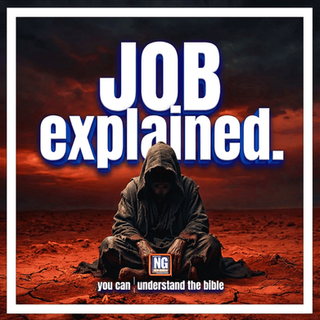
The Book Of Job
Master the message of Job — the suffering of the righteous, the sovereignty of God over evil, and the cry for a Redeemer who lives.
What Is The Book Of Job About?
Last updated: June 2026
The Bible's deepest engagement with innocent suffering — a blameless man loses everything, his friends insist he must have sinned, and God finally answers not with explanations but with Himself. The question at its heart: can God be trusted when life makes no sense?
Who Wrote Job?
Job is anonymous — no author is named — though its patriarchal setting (c. 2000–1800 B.C.) is signaled by its social world, long lifespans, and Job offering sacrifices as head of his household, with no mention of Israel or the Mosaic Law. At 42 chapters it is the longest wisdom book, a prose prologue and epilogue framing the Old Testament's largest section of Hebrew poetry. John Calvin preached 159 sermons on Job.
Primary Themes Of Job
God's sovereignty over suffering — Job's affliction unfolds only within God's permission and purpose (Job 1–2).
The failure of retribution theology — the friends insist suffering proves sin; God overturns their tidy formula (Job 42:7).
The cry for a Redeemer — "I know that my Redeemer lives" (Job 19:25) — the longing for a Mediator between God and man.
The limits of human wisdom — God answers not with explanations but with Himself; trust, not comprehension, is the resolution.
 The Lord Gives, Takes Away Job was righteous. Job suffered. Blessed be the name of the Lord. Listen & Read → 2 When You Don't Understand Why Job's wife said, 'Curse God and die!' He would not. Listen & Read → 3 With Friends Like These Job's friends came to comfort. They made everything worse. Listen & Read → 4 God Responds To Job From the whirlwind, God answered Job — not with explanation, but with creation itself. Listen & Read → 5 The Restoration Of Job God restored what was lost — and doubled it. Suffering is never the final word. Listen & Read → 6 When We Ask God Why (Bonus) Is it wrong to ask God why? Job asked. Here is what happened. Listen & Read →
 Key Verses In The Book Of Job
These are the passages that anchor the theology of Job — the texts to which Reformed theologians have returned when teaching the sovereignty of God in suffering, the mystery of providence, and the believer's hope in a living Redeemer. Job is the great Old Testament book of the doctrine of providence (Westminster Confession, Chapter 5), and these verses show why.
"Naked I came from my mother's womb, And naked shall I return there. The LORD gave, and the LORD has taken away; Blessed be the name of the LORD."
"Shall we indeed accept good from God, and shall we not accept adversity?" In all this Job did not sin with his lips.
"Though He slay me, yet will I trust Him. Even so, I will defend my own ways before Him."
"For I know that my Redeemer lives, And He shall stand at last on the earth; And after my skin is destroyed, this I know, That in my flesh I shall see God, Whom I shall see for myself, And my eyes shall behold, and not another. How my heart yearns within me!"
"But He knows the way that I take; When He has tested me, I shall come forth as gold."
"I have heard of You by the hearing of the ear, But now my eye sees You. Therefore I abhor myself, And repent in dust and ashes."
Job is far more than ancient wisdom about suffering; it is a book that aches for Christ before His coming. Job longs for a mediator who can stand between God and man, cries out for a Redeemer who lives, and is finally vindicated after his suffering — each a shadow of the Lord Jesus. Where Genesis foreshadows the Savior in promise and type, Job foreshadows Him in the groaning of a righteous sufferer who looks beyond the grave.
Christ Our Living Redeemer (Job 19:25–27): "For I know that my Redeemer lives, And He shall stand at last on the earth." Job's go'el — the kinsman-redeemer who buys back and vindicates his own — is fulfilled in Jesus Christ, who took our flesh, redeemed us by His blood, and rose bodily from the dead. Job's certainty that he would see God in his own resurrected flesh is answered in the risen Christ, the firstfruits of those who sleep, who will stand upon the earth at the last day.
Christ The Mediator Job Longed For (Job 9:33): "Nor is there any mediator between us, Who may lay his hand on us both." Job feels the infinite distance between a holy God and a guilty man and cries out for an umpire who can lay a hand on both parties at once. There was no such mediator in Job's day — but there is now. "For there is one God and one Mediator between God and men, the Man Christ Jesus" (1 Timothy 2:5). Christ alone is both God and man, able to lay His hand on both and reconcile them.
Christ The Innocent Sufferer Who Is Vindicated: Job suffers not for his sins but under the testing hand of God, accused by Satan and misjudged by men, yet finally declared righteous and restored. He is a type — imperfect, for Job too must repent — of the truly innocent Sufferer. Jesus, the only blameless One, was accused by the adversary, condemned by men, and forsaken in our place, then vindicated and exalted by the Father.
Christ The Revelation Of God From The Whirlwind: When God answers Job, He gives not an explanation but a self-revelation of sovereign wisdom and power (Job 38–41). Job is silenced and satisfied by seeing God. In Christ, God's final word is spoken: "God, who… spoke in time past… has in these last days spoken to us by His Son" (Hebrews 1:1–2). The God who answered Job from the whirlwind has now drawn near in the face of Jesus Christ.
Christ Our Restoration After Suffering (Job 42:10–17): Job's latter end is blessed more than his beginning — a restoration that points beyond itself to the resurrection hope of all who suffer in Christ. The pattern of suffering followed by glory finds its ground in the One who endured the cross before the crown, so that the believer's afflictions are "but for a moment," working "a far more exceeding and eternal weight of glory" (2 Corinthians 4:17).
This is the gospel New Geneva Theological Seminary exists to guard and proclaim. Dr. Toby Holt's expository series through Job preaches Christ from the patriarch's anguish verse by verse — holding fast to the sovereignty of God in suffering with the full weight of Westminster-confessional theology, and pointing the afflicted church to the living Redeemer who stands at last on the earth.
The cry of Job for a living Redeemer and a Mediator between God and man (Job 19:25) is answered in the Gospel of John, where the Word becomes flesh to stand in that place.
Frequently Asked Questions About The Book Of Job
Job is an Old Testament book that confronts the problem of suffering: why a righteous man endures devastating loss under the sovereign hand of God. Job, "blameless and upright" (Job 1:1), loses his children, wealth, and health, then wrestles with God and three friends over the meaning of his pain. The book's answer is not a tidy explanation but a revelation of God Himself, who is sovereign, wise, and worthy of trust even when His ways are hidden.
The human author is unknown; Scripture does not name him. Many conservative scholars regard Job as one of the oldest books in the Bible, with events set in the patriarchal era (note Job's long life and his role as family priest, with no mention of the law of Moses). Whatever its date of composition, the church has always received Job as the inspired, God-breathed Word of God, authoritative for the doctrine of providence.
Job shows that suffering is not always punishment for sin and is never outside God's sovereign control. God permits the affliction of His servant for purposes Job never fully learns — to display that genuine faith loves God for Himself, to refine His child "as gold" (Job 23:10), and to magnify His own glory. The Westminster Confession (5.5) teaches that God uses affliction to chasten, humble, and draw His children nearer.
Satan ("the accuser") appears among the angels before God's throne, where he challenges the genuineness of Job's faith. Crucially, Satan can do nothing without God's permission and only within strict limits God sets (Job 1:12; 2:6). The scene reveals that even the devil is on a leash, subject entirely to the sovereign decree of God. This is the Reformed doctrine of providence: God governs all things, including the actions of evil powers, for His own holy ends.
In the depth of his suffering, Job confesses faith in a living go'el — a kinsman-redeemer who vindicates and rescues his own — and in his own bodily resurrection: "in my flesh I shall see God" (Job 19:26). It is one of the earliest clear hopes of resurrection in Scripture. The Reformed church reads it as a prophetic glimpse of Christ, the living Redeemer who will stand upon the earth at the last day.
No. Eliphaz, Bildad, and Zophar assumed that suffering is always direct payment for personal sin, so they insisted Job must have sinned greatly. God Himself rebukes them: "you have not spoken of Me what is right, as My servant Job has" (Job 42:7). Their error was a rigid, mechanical view of retribution that ignored God's freedom and the reality of innocent suffering — a warning against simplistic explanations of pain.
God answers not with explanations but with questions: "Where were you when I laid the foundations of the earth?" (Job 38:4). Through a majestic tour of creation, God reveals His wisdom and power, showing Job that the Creator who governs the cosmos can be trusted with one man's suffering. Job is humbled and satisfied — not because his questions are answered, but because he has now seen God (Job 42:5).
Job longs for a mediator to stand between God and man (Job 9:33), fulfilled in Christ, the one Mediator (1 Timothy 2:5). He confesses a living Redeemer who will stand on the earth (Job 19:25), fulfilled in the risen Christ. Job is an innocent sufferer vindicated after affliction — a shadow of the sinless Savior who suffered in our place and was raised in glory. The whole book aches for the Christ who would come.
Yes. Scripture treats Job as a genuine historical figure, not a parable. Ezekiel names him alongside Noah and Daniel as a real example of righteousness (Ezekiel 14:14, 20), and James points to "the perseverance of Job" as an actual case of endurance under trial (James 5:11). The Reformed tradition has consistently received Job as a true account of a real man under the sovereign providence of God.
Job is a primary biblical foundation for the doctrine of providence in Westminster Confession Chapter 5 — God's wise and holy government of all His creatures and actions, including His sovereign restraint of Satan (Job 1–2) and His fatherly chastening of His own children (WCF 5.5). It also illustrates God's eternal decree (Chapter 3), by which He ordains whatsoever comes to pass. New Geneva Theological Seminary teaches Job within this Westminster-confessional framework.
Westminster Connections
No book of Scripture tests and confirms the doctrine of providence like Job, and the Westminster Standards confess what Job dramatizes. WCF Chapter 5 (Of Providence) teaches that God upholds, directs, and governs all creatures and actions — even Satan's assault on Job is permitted only within the bounds God sets (Job 1:12; 2:6), and the afflictions of the righteous serve His wise and holy ends, including the fatherly chastening of His own children (WCF 5.5). Behind Job's trials stands WCF Chapter 3, God's eternal decree by which He ordains whatsoever comes to pass, and Job's closing repentance before the LORD models the creature's right submission to the Creator's sovereignty. John Calvin devoted 159 sermons to Job for precisely this reason: it is the Bible's great school of providence, teaching the church to trust God's hand even when His purposes are hidden.
Recommended Reading
Sermons on Job
by John CalvinJob: The Wisdom of the Cross
by Christopher AshThe Storm Breaks: Job Simply Explained
by Derek ThomasJob (Tyndale Old Testament Commentary)
by Francis I. Andersen
Study The Book Of Job At New Geneva Theological Seminary
New Geneva Theological Seminary has equipped ministers and lay leaders in Westminster-confessional theology since 1993. Our expository preaching series through the Bible — including this study of Job — reflects the same commitments that shape our degree programs: Scripture is the Word of God, the Westminster Standards faithfully summarize its teaching, and sound doctrine must produce pastoral practice.
Whether you are pursuing ordination in the PCA, OPC, RCUS, or other denominations — or simply want to go deeper in God's Word — New Geneva offers affordable, Reformed theological education that works around your life and calling — the M.Div., Th.M., and MACM, taught live online, all at $300 per credit hour. For the Doctor of Ministry, contact the registrar about schedule and format.