How Has Jesus Overcome the World? (John 16)
In the world you will have tribulation — but take heart: He has overcome the world.

About This Sermon
What does Jesus offer His followers on the night before His crucifixion? Not the promise of an easy life, but a peace the world cannot give. In this expository sermon on John 16, Dr. Toby B. Holt walks through Christ's final words to His disciples in the Upper Room, where sorrow is promised yet declared temporary, and tribulation is promised yet declared already conquered. From a confessional Reformed perspective, the believer's assurance rests not on calm circumstances but on the finished, sovereign victory of the risen Lord, who says, "In the world you will have tribulation; but be of good cheer, I have overcome the world" (John 16:33, NKJV).
Walking through this yourself? What Does the Bible Say About Anxiety and Worry?
Sermon Chapters
Select a chapter to play the audio from that moment, or “Read” to jump to that part of the transcript below.
Questions This Sermon Answers
Jesus tells the disciples, "A little while, and you will not see Me; and again a little while, and you will see Me, because I go to the Father" (John 16:16, NKJV). The first "little while" points to His death and burial; the second to His resurrection appearances. His departure was not abandonment but the necessary path to the cross, the empty tomb, and His return to the Father's glory.
Their sorrow at the cross is real but temporary. Jesus promises, "you will be sorrowful, but your sorrow will be turned into joy" (John 16:20, NKJV). The resurrection does not merely replace grief with gladness; it transforms the very cause of their mourning into the ground of their rejoicing. The crucified Lord rises, and the source of despair becomes the fountain of hope.
Jesus compares their grief to childbirth: "A woman, when she is in labor, has sorrow because her hour has come; but as soon as she has given birth to the child, she no longer remembers the anguish, for joy" (John 16:21, NKJV). The pain is severe yet purposeful and brief, swallowed up by the joy it produces. Present suffering gives way to a lasting gladness no future event can undo.
Jesus says, "your heart will rejoice, and your joy no one will take from you" (John 16:22, NKJV). This is not happiness tied to circumstances but joy grounded in the living Christ Himself. Because His resurrection is permanent and His presence secured, the believer's joy is rooted in an unchanging Savior, beyond the reach of the world, sin, or death.
"For the Father Himself loves you, because you have loved Me, and have believed that I came forth from God" (John 16:27, NKJV). Reformed theology confesses that the Father's love is not won by our merit but flows from His eternal good pleasure in His Son. Those united to Christ by faith are loved with the same love the Father bears toward Him, secured in the covenant of grace.
Jesus foretold, "you will be scattered, each to his own, and will leave Me alone. And yet I am not alone, because the Father is with Me" (John 16:32, NKJV). Even in His deepest trial He rested in the unbroken fellowship of the Father. This points to His unwavering trust in divine providence, the truth the Westminster Confession affirms when it teaches that God upholds and governs all things by His most wise and holy providence.
"These things I have spoken to you, that in Me you may have peace" (John 16:33, NKJV). This peace is located "in Me," not in favorable conditions. It is the settled assurance that flows from being reconciled to God through Christ. As Scripture says elsewhere, "having been justified by faith, we have peace with God through our Lord Jesus Christ" (Romans 5:1, NKJV).
No. Jesus is explicit: "In the world you will have tribulation" (John 16:33, NKJV). He promises not the absence of trouble but His own overcoming peace within it. Scripture affirms that "all who desire to live godly in Christ Jesus will suffer persecution" (2 Timothy 3:12, NKJV). The Christian life is marked by tribulation, yet bounded by the certainty of Christ's triumph.
Jesus declares, "be of good cheer, I have overcome the world" (John 16:33, NKJV). Spoken before the cross, it announces a victory already certain. Through His death and resurrection, Christ has decisively conquered sin, Satan, and death. His people share in that triumph, for "in all these things we are more than conquerors through Him who loved us" (Romans 8:37, NKJV).
Because the victory belongs to Christ and not to us, our assurance is as secure as He is. The believer's confidence rests on His finished work, not on personal strength or steady circumstances. The Westminster Confession teaches that those whom God has accepted in Christ can never finally fall away but are kept by His power. The risen Lord who overcame the world holds His people to the end.
Reformed theology reads Christ's declaration in John 16:33 as an accomplished, decisive victory in which believers already share by union with Him. John Calvin, commenting on this passage, stresses that Christ speaks of His conquest as finished, so that His people face tribulation not as those who might yet be defeated but as those enfolded in a triumph already won. Thus present sorrow is real but temporary; the outcome is settled, and courage rests on His victory, not our own.
Key Theological Points
1. Sorrow That Will Not Last
On the eve of the cross, Jesus does not deny His disciples' coming grief; He reframes it. Their weeping is real, but it has an expiration. "Most assuredly, I say to you that you will weep and lament, but the world will rejoice; and you will be sorrowful, but your sorrow will be turned into joy" (John 16:20, NKJV). The resurrection does not merely comfort the mourners; it converts the very ground of their sorrow into the ground of their joy.
2. A Joy No One Can Take
The joy Christ promises is not fragile or circumstantial. It rests on His living presence after the resurrection, and therefore nothing in the world can seize it. "Therefore you now have sorrow; but I will see you again and your heart will rejoice, and your joy no one will take from you" (John 16:22, NKJV). Because the risen Christ cannot die again, the believer's joy is anchored in an unchanging Savior, secure against every loss.
3. Not Alone, Because the Father Is With Me
Jesus foresees His abandonment by frightened friends, yet He is not shaken, for His confidence is in the Father. This is providence held by faith in the darkest hour. "Indeed the hour is coming, yes, has now come, that you will be scattered, each to his own, and will leave Me alone. And yet I am not alone, because the Father is with Me" (John 16:32, NKJV). The same Father who sustained the Son sustains all who are His in Christ.
The Scripture Text: John 16:32-33 (NKJV)
"Indeed the hour is coming, yes, has now come, that you will be scattered, each to his own, and will leave Me alone. And yet I am not alone, because the Father is with Me. These things I have spoken to you, that in Me you may have peace. In the world you will have tribulation; but be of good cheer, I have overcome the world."
Continue studying: explore the full Gospel of John sermon series, or browse the complete Reformed Sermon Archive.
About Our Speaker

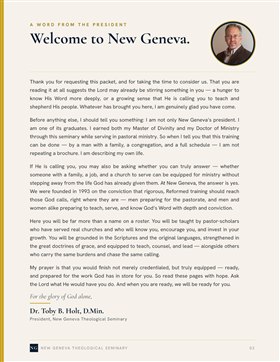
About The Speaker: Dr. Toby Holt serves as the third President of New Geneva Theological Seminary (Colorado Springs, CO), founded 1993. An expository preacher with over 1.9 million sermon downloads on SermonAudio.com, Dr. Holt brings over 17 years of pastoral experience to his verse-by-verse Bible teaching. New Geneva offers Reformed theological education — the M.Div., Th.M., MACM, and Certificate of Biblical Studies, taught live online. For the Doctor of Ministry, contact the registrar about schedule and format.
Sermon Transcript
Summary. In this expository sermon on John 16 from the Gospel of John series, Dr. Toby Holt of New Geneva Theological Seminary teaches that there is no spiritual neutrality: all mankind is already divided into two camps, sheep and goats, and Christ's people can face tribulation with hope because Jesus declared, 'I have overcome the world.' Preaching from the Reformed and Westminster tradition, Dr. Holt shows that God tests and refines the faith of those He loves, walks with them through the valley of the shadow of death, and guarantees their final victory in Christ.
The Promise of Christ's Victory Over the World
“These things I have spoken to you, that in Me you may have peace. In the world you will have tribulation; but be of good cheer, I have overcome the world.”
— John 16:33 (NKJV)
When shadows fall and life gets hard, we cling to this promise, that Christ has not left us alone. In John 16, Jesus told His disciples that dark days would come, but in time, so would their victory. Be of good cheer, He told them, for I have overcome the world.
Continue reading the full transcript 27-minute read · 15 sections · every section links back to the audio
The Myth of Spiritual Neutrality
In our culture, we think that there are Christians and there are non-Christians and there's people in the middle. We think that we come into this world as a blank slate, a blank canvas, and that in due time we hear religious things and we either choose to believe them or we don't. But we think that there's this place that we have been in in times past and possibly today that is neutral to the things of God.
Not necessarily for, not necessarily against, and the culture around us, the academic world, the institutions believe just that. They believe in this myth of spiritual neutrality. However, that is absolutely positively not the teaching of Scripture. Last week we saw this.
There's no spiritual free agents. There's no spiritually neutral individuals.
Two Camps at the Final Judgment: Sheep and Goats
You know, on the last day, the day of judgment, all of mankind is to be gathered before Jesus Christ. In the book of Revelation, we see this. All of mankind is to be gathered before Jesus Christ. Now, let me ask you, when He separates mankind at that time, how many categories or camps does He separate them into?
You want to guess? Oh, I heard two from multiple sides of the room. Do we agree? We think it's two?
Yes, it is two. It's not three. It's not five. It's not ten.
Two camps, sheep and goats. At that time, God will separate all of mankind into two camps, sheep and goats. Well, here's the thing. They're in those camps right now.
All of mankind right now is sheep or goats. There is none who are righteous. No, not one. There's none who are spiritually neutral.
No, not one.
Christ's Mission to Die for His People
Well, early in chapter 16, in the text just prior to the verses we're studying this morning. Jesus said, I'm going to die. I'm going to die. In fact, that's why I came here.
Newsflash. He kept telling the disciples that across the core of his ministry, the whole of His ministry. He said, this is why I'm here. This is the mission.
I didn't come just to turn water to wine. I didn't come just to heal people. I didn't come just to do miracles and the like. I came to die.
I set My face like a steel flint to the cross. That's why I'm here. Now, when He would say that, His disciples would go, oh no, It can't be. Far be it from you that that should happen.
Even Peter, the rock says that. Far be it. Can't happen, won't happen. Jesus looks at him and says, get behind Me, Satan.
The temptation is that I shouldn't go to the cross, but I must go to the cross. Peter, if you're to be saved, and you, and you, and you, and you, if anyone is to be saved, it's because I go to the cross and bear the sins of My people. I have to do it.
That's why I'm here.
Two Reactions to the Cross: The Disciples Weep, the World Rejoices
With that said, earlier in chapter 16, Jesus said — He says, all right, here's what's going to happen. I'm going to die, and there's going to be two different reactions to My death, to My sacrifice. In John 16:20, He said this: Most assuredly, I say to you, to his disciples, that you will weep and lament.
I'm going to the cross. I'm going to die. And when I do so, I know that you will weep and lament. You will miss the time that we had together.
You will miss Me. You will think this is the end. I know that's what's going to happen. You will weep and lament, in verse 20.
But, but the world, meaning everyone else, will rejoice. Jesus says, this sweet, gentle Jesus, this guy that no one should have hated. For what it's worth, the fact that anyone ever hated Jesus Christ, this gentle guy who goes around healing everyone He touches, you'd think that would be the most popular guy on the globe, that everyone would love that guy.
Kind, gentle Jesus that sits with sinners and tax collectors and hears their problem and heals their sicknesses. You'd think He'd be the most lovable guy on planet Earth. Of course, He was not only crucified, but He's been hated with such a lasting hatred that 2,000 years later, people still hate Him. If there's anything that demonstrates that He was who He said He was, and that they're truly all of mankind would be divided into goats and sheep and no one's spiritually neutral, it's the proof that He is still hated with the passion with which he is hated 2,000 years later, despite being the most lovable guy to ever walk the globe.
With that said, He says, when I die, you're gonna be sad, but the world at large, they're gonna have a party. They're gonna rejoice is the word He says in verse 20.
The World's Rejection of God: 'Is God Dead?'
You know, the world has always been chomping at the bit to do away with Jesus and religion and church and all that sort of stuff. In 1966, Time magazine — is Time even still a thing? Is that still a thing? Time magazine, if you have a little bit of gray up top, at some point in your life, you've picked up a Time magazine.
Well, in 1966, they published a famous cover, famous article, three words, one question. The question was this: is God dead? And then they went on to make the case that, yeah, He was. Or at the very least, that society had evolved past Him.
We no longer really need to believe in a God. Why? Because science has given us all the cures and the answers and the things. We're no longer the superstitious rubes that we used to be culturally, so we can kind of do away with all the stuff we used to believe in and so forth.
Even in 1966, that was the mindset. Well, that mindset hasn't changed. The mindset to this day is that God, if He's not dead, at the very least, He's weak or He's indifferent or He's far away and that He is not actively present. And so the world goes about its business thinking that they can do whatever they want to do, as if there's not a holy and transcendent God who's looking down upon them and ready in due time and His time and the fullness of time to deal with their wickedness.
The world goes on doing its thing, rejoicing in the sense that God is not there or not paying attention or possibly dead, and so they live accordingly. Meanwhile, we in the church, and we in the global church that is actively persecuted in many parts of the world, we suffer in the here and now, even while the world continues to party.
The Wrath of the Lamb at Christ's Return
But no, here's the thing. It's not always going to work that way. What happens when Jesus returns? Let me read you one passage, and then I'm going to go on to look at verses 25 to 30 of today.
But when Jesus comes back, finally, at the end, Revelation chapter 6, here's going to be the reaction. The sky will recede as a scroll, and every mountain and island will be moved out of its place. And the kings of the earth, the great men, the rich men, the commanders, the mighty men, every slave and every free man will hide themselves in the caves and the rocks of the mountains, and will say to the mountains and will say to the rocks, fall on us and hide us from the face of Him who sits on the throne and from the wrath of the Lamb.
For the great day of His wrath has come, and who is able to stand? If you look around and it looks like the world is winning — and to the disciples, it had to look that way. When Jesus was caught up in the Garden of Gethsemane and ultimately led to the cross, it had to look like the world had won.
Revelation 6 says, not so fast. So let's look at these verses. Again, I'm going to reread verses 25 to 30, and we'll just work our way through as time permits this morning.
Direct Access to the Father Through Christ
Verse 25, this is occurring in the course of a long passage of text. A lot of red lettering, depending on your scripture there. Verse 25, these things I've spoken to you in figurative language. He did that a lot.
He explained difficult things in language that at times made it very simple, but at times left the people confused. So these things I've spoken to you in figurative language, but a time is coming when I will no longer speak to you in figurative language, but I will tell you plainly about the Father.
And in that day, you will ask in My name, and I do not say to you that I should pray to the Father for you, because the Father Himself loves you, because you've loved Me, and you believed that I came forth from God. I came forth from the Father. I've come into the world.
Again, I leave and I go to the Father. Now His disciples said to Him, see, now you're speaking plainly and you're not using any figure of speech. Now we're sure that you know all things and you have no need that anyone should question you. By this we know that you've come forth from God.
As a quick side note, you want one of the richest passages of text you'll ever see where Jesus explains a whole lot of significant things in a very dense set of words. You see, His preexistence, His incarnation, His atonement, His resurrection, His ascension, all there in verses 28 through 29. With that said, the disciples were not in any position to pick up on all of that at that time.
Preexistence, incarnation, atonement, resurrection, ascension. You know, as He's talking, they're catching about one out of every five or six words and trying to nod and understand exactly what's taking place. Now, you and I, when we open the Bible, most of us know how this story plays out. So we know everything's going to be all right.
You know, the disciples are freaking out here. Do not let your heart be troubled, Jesus says to the disciples. And we were kind of echoing that. Come on, disciples, it's going to be all right.
It's going to be all right. You're flipping the pages. It's going to be all right. He's going to live.
He's going to be resurrected. He's going to ascend to the Father. We know how it's going to turn out. They didn't.
They really, truly didn't. They had Christ's promises, and that did mean a lot to them. It would mean an increasing lot to them as time would continue to go by. But at the same time, they didn't have the benefit of all that we have, which is the entirety of this book, to look at.
We know how the story ends. They didn't at this time. And so they were often confused. And they would tell them they were confused, or they'd talk amongst themselves about how confused they were.
Earlier on in chapter 16, Jesus said, a little while and you will see Me, and then after a little while you will not see Me because I go to the Father. Some of His disciples said among themselves, what is this He's saying to us? A little while and you will see Me, and a little while after that you will not see Me because I go to the Father.
They said, therefore, what is this that He's saying in a little while. We do not know what He's saying. Jesus would talk about dense stuff and they wouldn't get it. As a side note, if you've ever been in church, maybe even right now, and you're like nodding your head and going, all right, all right.
I mean, I've did that through all the seminary. I've nodded my head, all right, all right. It didn't mean I understood exactly what was taking place. If there's ever any time where you're hearing stuff and you know it's true, but you don't necessarily know why and you're not connecting all the dots, join the club.
The disciples, the disciples, the apostles, were in the same boat, and they had a far better preacher preaching to them. They were hearing words from the lips of God Himself that were 100% true down to the very last syllable, and they still didn't get it. For many of us, it's just a process.
The Gift of the Holy Spirit as Helper
So whatever the case is, Jesus here is explaining stuff they're not all getting, but among the things that he's explaining to them in verses 25 through 33 is that, hey guys, you have, through Me, direct access to the Father. He says, what you've probably been thinking is that this is the relationship: God the Father's up there and I'm right here in front of you, and I'm sort of a go-between intermediary where you can say something to Me and I'll go whisper it to the Father, and that that's exactly how this works.
Sort of, Roman Catholicism does with the Pope. You have sort of this guy that sort of represents all of us, and then take stuff up the chain of command. Well, what Jesus says here is that no, no, no, no, no. In so many texts, He says, I and My Father are one. When you're talking to Me, you're talking to Him.
When you're sharing with Me, when you're asking Me, when you're pleading to Me, you're pleading to Him. And He says, guys, this is such an advantage that you have. He's talking about the Trinity. And just a few verses earlier, He says, when I go, when I go, I'm going to give you an advantage that's going to be so significant that you won't possibly understand it until it happens.
I'm going to send a helper. I'm going to send a helper to — I'm going. Yes, I'm going to go, and you're going to be sad because I'm gone, but I'm going to send you a helper. The helper's going to come down on the day of Pentecost, Acts chapter 2.
The Spirit's going to come down. He's going to fill your heart. He's going to fill your heart and lead you in the path of righteousness, and it's such an advantage to you. Again, so much of this, all they could do is just kind of nod, nod politely and accept that it was true, but not fully understand it, at least at this time.
But in time, God would open their eyes, open their ears, open their hearts to see and take all this in and understand it to a degree they didn't even understand at this time.
The Weakness of the Disciples' Faith
This is true of all of us and how we grow in faith. All right, let's look at verses 31 and 32. Now, in the previous verses, the disciples said, hey, I think we're starting to figure this out. Now that you're speaking plainly, I think we got this.
I think we believe. So in verse 31, Jesus answered them, and with either irony or sarcasm, He says, now, now you believe? Now you get it? Now you believe?
Now, at this point He knows that they don't fully believe, or at least they don't believe to the degree that when they're tested that belief isn't going to crumble like a pile of sand in your hand. Their belief at this time is still weak, and He knows it, because look what He says next.
He says, do you now believe? Indeed, the hour is coming, yes it is now come, it's right here, it's at the door, my betrayer just went out, is now come, when you will be scattered, each to his own, and you will leave me alone, and yet I'm not alone because the Father's with me.
So they say, all right, we got it, Jesus, we're — now we believe, we believe, amen. How many times have we sung that song, I surrender all, right, when in our hearts if we're really pressed what we know is it's, I surrender some. Here they say, we believe you, all, we believe, we're with you to the end.
How many times did Peter say, I'll go with you right to hell's gates. I'll stand to the end. Jesus says, I'm glad you think you have that faith. I'm glad you believe that you do.
But a moment's coming when you're just going to be scattered. You're all going to go to the winds. You're all going to go to the winds. And you're going to deny that you even knew me.
You know, before the rooster crows, Peter, three times. Peter is the strongest, typically. That's how we understand him to be. Well, the strongest was going to melt in very short order.
So Jesus says, do you now believe, when He knew what was about to happen. And He knew that their faith was about that high. And that when it was tested, that it would crumble. He says, do you now believe?
The Rabbi and His Disciples: The Model of Discipleship
You know, there are few relationships in the first century or any century that are like that between a rabbi and a rabbi's disciples. See, we have no context for understanding that. If you've gone to college, you have a professor and you have students. As a student, do you ever go hang out with your professor?
Do you ever follow the professor around? Do you go to have lunch with the professor? Do you wake up at breakfast with the professor? Do you just hang out, campfires, you know, go to the movies with the professor?
Probably not. In the case of a rabbi and his disciples, the disciples went everywhere that the rabbi went. They sat at his feet, they learned from him whenever he spoke, which was often, but they also learned just by observing his mannerisms, who he is, his walk of life, the things he did. And the objective is that they ultimately would match the rabbi's stride.
Where this rabbi's footprints went, the idea is that they would match his stride, figuratively speaking. That in due time, after the rabbi was departed, they would have taken so much in from their relationship with the rabbi that when you looked at them, in a sense, you would be seeing him, which is a model of what discipleship is supposed to look like.
Christ is our head. We're supposed to adapt and be modeled after Him. Now, the relationship was so close among rabbis and disciples, it was not unusual for the disciples to be referred to as the children of the rabbi. That's why when you read through the epistles, John does this actually quite a lot.
He says, my little children, when he's writing letters, it's because the nature of relationship was so close. So the intimacy and the relationship between the rabbi and the disciples, you cannot overstate it. With that said, this relationship had gone on for over three years, where they had eat, slept, gotten up, went to travel, did all these different things with Jesus, with their rabbi, and now He was about to go.
The betrayer had just left. The enemies of Christ and them were gathering to deal with them. They were freaking out. Christ is going to be gone.
We are going to be separated. They didn't like any part of that because proximity to Him is what made them a disciple. Proximity. But the irony was, even though it was Jesus who was volitionally going to the cross and ultimately to the Father — although He was volitionally going to go, the irony was that despite their closeness to Him, their proximity, and how much they loved and desired that, what Jesus said in this verse is He says, you're going to leave me before I ever leave you.
All the Disciples Forsook Him and Fled
Before I ever go to the Father, you'll have already run away from me the minute the persecution comes, which at that point was just around the corner. In Matthew 26, in the Garden of Gethsemane, remember they go up to Mount of Olives, they go to the Garden of Gethsemane. Well, Judas is going to come too, and the priests and the soldiers and the like are going to come.
So what we read in Matthew 26 is this. In that hour, Jesus said to the multitudes, to those who gathered against Him on the Garden of Gethsemane, He says, have you come out to me as against a robber with swords and clubs to take me? This gentle Jesus, this guy who heals everyone, who never said a wrong thing, who was polite and courteous and the like, they came to get Him with swords and clubs, this Jesus.
So He questions. He says, have you come out to me as you would, you know, a robber, a villain with your swords and clubs to take me? I sat daily with you. I was teaching the temple.
You didn't seize me then. But all of this was done, Jesus said, that the scriptures of the prophets might be fulfilled. He says, read your Bibles. You'll see that what you're doing right now in the Garden of Gethsemane coming after me was prophesied in scripture.
After you do all this and after I'm dead and buried and resurrected, go back and read it. You'll see. You'll see that everything you did this night was prophesied there in Scripture. Now, after He says that, that all this was done, that the Scripture of the prophets might be fulfilled, Matthew 26 says this, Then, then all the disciples forsook Him and fled.
Not some, not one, not two. All of the disciples forsook Him and fled. They thought they were much stronger than they were. You and I think we're much stronger than we are.
What if you're tested? How will you hold up?
God Tests and Refines the Faith of Those He Loves
“Yea, though I walk through the valley of the shadow of death, I will fear no evil; for You are with me.”
— Psalm 23:4 (NKJV)
Well, here's the thing. If God loves you, He will test you. If God loves you, He will bring things into your world that will rock your world and test your faith to see what kind it is. If He loves you, He'll do that because faith grows in hardship.
Whatever faith you have today, whatever it is, such as it is, and however many years you have left, however many they are, I assure you this, that if the rest of your days were nothing but sunshine and lollipops, nothing but lottery tickets and big wins and successes and the like, I assure you, you will grow in your faith far less than if God allows cancer, than if God allows difficulty, if God allows hardship, God allows difficulties to come to you.
Those things will test and try and refine your faith in a way that a lottery ticket win never would. So if He loves you, what's He going to do? Is He going to give you everything that you would want for yourself, or is He going to give you some things you would never desire for yourself?
Why? Because those things will prompt and cause your faith to grow. You know the answer. But even as He does that, even as He brings things into your life that you would never choose for yourself, He says this much, I'm not going to stand back and watch you undergo it from a distance with my arms folded just to see how you do.
He says, I'm going to come with you. We're going to lock arms and we're going to do this together. Yea, though I walk through the valley of the shadow of death, I shall fear no evil. Why?
For Thou art with me. God, You have ordained me to sit at a table with my enemies. Yes, You have ordained I should walk the valley of shadow of death. And yeah, I don't like it.
No one would. No one likes the valley of the shadow of death. There's a reason it's called the valley of the shadow of death. It's terrible.
Jesus knows that. But He says, I will be with you as you face it.
The Victory That Overcomes the World Is Our Faith
And that's the hope. That's the victory. Not only will I be with you as you face it, but I know the outcome, and so do you. Your story ends well.
The victory that's overcome the world is your faith. We read that earlier this morning. The victory that's overcome the world is your faith. Why?
Because when those hardships come, you, through your faith, can see beyond it. You can see, yes, today is terrible, and I don't like it, and yes, tomorrow doesn't look any better, but, but, my story ends well. I know where I'm going. I know whose hands I'm in, and even if I don't like the circumstances that He allows me to go through, I know He's with me, and it won't change tomorrow, even when I mess up.
Even when I'm the Peter, even when I run from God, even when I do what's wrong, even when I should mess up hugely, I know He will not leave me. Why? Because even though while I'm faithless, He's faithful, and He made me a promise. And He's going to keep that promise.
Dear heavens, there's a lot of gray hair in this room. You're on the second half of your journey if you have some. With that said, the second half of our journey, that's all right. I know where I'm going.
Do you? When you know where you're going, then even tomorrow is terrible. You say, well, yeah, tomorrow's terrible, but God's with me. My story ends well, and I've got eternity to dwell in sinless existence without all the hardships and things I hate right now.
And that's just around the corner. All right, let's look at our very last verse that ties into this, verse 33. These things I've spoken to you, that in Me you may have peace. In the world you will have tribulation.
It's not may, you will. In the world you will have tribulation, but be of good cheer. for I have overcome the world.
'It Is Well With My Soul': Horatio Spafford and Assured Victory
You know, there's a famous hymn. It's by a guy with an old school name, Horatio Spafford. Does anyone know what hymn I'm talking about? I bet some of you do.
Hey, there we go. Horatio Spafford, 1870-something. Horatio Spafford, his wife and his children go on a transatlantic boat. They're going on the ocean.
They're in a boat. The boat sinks. The children die. The wife is spared in some way by clinging to the debris, but the children are gone.
Horatio Spafford. The heart is broken. Over the years, he and his wife have a lot of cause to ask God, what are You doing? What were You doing with this?
At the very least, it should have been us. As a parent, can you relate to that? At the very least, God, I wish You'd just taken me, not them. There can be anger and bitterness and resentment at the circumstances and questions God about allowing the circumstances.
But in working that through, Horatio Spafford came to the consideration of this, that in the end, his story ends well, and so did that of his wife and his children. And so he wrote this famous hymn, It is well with my soul, in spite of circumstances that were not well at all. It is well with my soul.
Remember how that song starts? And I'm not going to sing it. I've sworn off singing. But it says this, when peace, when peace like a river attendeth my way, when sorrows like sea billows roll, that's not an insignificant word choice for a guy who lost his loved ones to the billows of the sea.
When peace like a river attendeth my way, when sorrows like sea billows roll, whatever my lot, thou hast taught me to say, it is well, it is well with my soul. Horatio Spafford, believe the same thing that our circumstances may compel us to believe and grab tight to with all of our strength.
That despite the things that we hate in this world, that God is in charge and that He has promised victory. And because that victory is right around the corner, because Jesus says, I have overcome the world, we can have hope. And we can go on with our life until the time when God takes us home into a place where He wipes away our tears and we never shed another one.
This morning, this morning, all of us collectively, if you ever watch a football game and there's about two minutes left in the game and the one team's up 99 to zero, you know how it's going to turn out. There's still time left on the clock, technically. There's still guys in shoulder pads, you know, bumping up against one another.
I'm borrowing an analogy from Gardner's World. There's still guys committed to fighting. There's still difficulty. There's still resistance.
There's still all of this going on, but the victory is assured. One team wins, the other team loses. Jesus says to this team, to the sheep, to the church, I have overcome the world, and so have you. Let's pray.
More in The Gospel Of John
Continue the verse-by-verse series.
Keep listening — every sermon is free.
160+ expository sermons with full transcripts, across 14 books of the Bible.